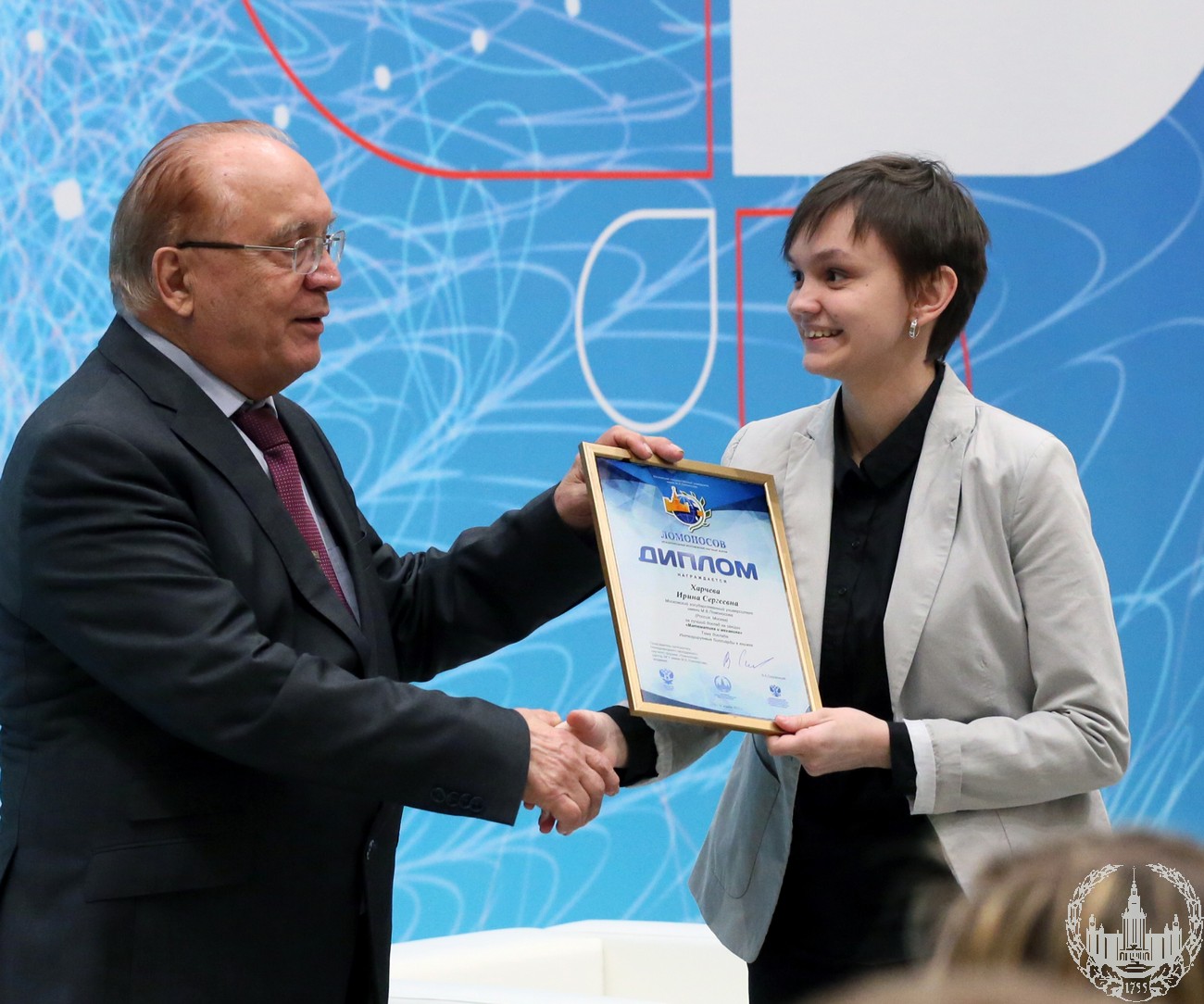
Awarding Irina Sergeevna Kharcheva. April 14, 2017
|
Language: Russian | English
Scientific achievements of the Department
Scientific achievements of the Department staffAnatoly Timofeevich Fomenko, full member of the Russian Academy of Sciences (RAS), full member of the Russian Academy of Natural Sciences, full member of the International Academy of Higher Education Sciences, full member of the Academy of Technological Sciences of the Russian Federation, Doctor of Physical and Mathematical Sciences, Professor, Head of the Department of Differential Geometry and Applications of the Faculty of Mechanics and Mathematics of Moscow State University. He solved the well-known Plateau problem in the theory of spectral minimal surfaces. Namely, he proved that in the class of multidimensional “surfaces” with a predetermined boundary, parameterized by the spectrum of manifolds with the same boundary, there always exists a globally minimal “surface” (that is, figuratively speaking, a multidimensional stratified “soap film” of the smallest volume). Further, A.T. Fomenko created a theory of fine classification of integrable Hamiltonian dynamical systems, discovered topological invariants of such systems, characterizing them up to Liouville equivalence. These invariants turned out to be effectively computable and with their help, for example, remarkable examples of integrable systems were discovered that were previously considered different, but in fact turned out to be topologically equivalent. Winner of the State Prize of the Russian Federation (in the field of mathematics) for a series of works on the theory of invariants of manifolds and Hamiltonian dynamical systems. Winner of the Moscow Mathematical Society Prize and of the Prize of the Presidium of the USSR Academy of Sciences. Author of more than 250 scientific papers, 30 monographs and textbooks, specialist in the field of geometry and topology, calculus of variations, theory of minimal surfaces, symplectic topology, Hamiltonian geometry and mechanics, computer geometry. He has delivered plenary lectures at international mathematical congresses and conferences. Alexander Olegovich Ivanov, Doctor of Physical and Mathematical Sciences, Professor, is a well-known specialist in the theory of topological variational problems, ramified extremals of one-dimensional variational problems, minimal networks, minimal fillings of finite metric spaces, minimal surfaces, differential, discrete and combinatorial geometry. Current scientific interests: geometric optimization problems (minimal networks, minimal fillings), discrete geometry (geometry of polyhedra, geometric graph theory), metric geometry (geometry of Alexandrov spaces, geometry of groups), computer geometry. For many years, together with Professor A.A. Tuzhilin, he has been leading a research seminar on the geometry of extremal networks, supervising coursework, diploma and dissertation works. Some current research problems can be found on department website and Delaunay International Laboratory. A.O. Ivanov and A.A. Tuzhilin published more than 100 scientific papers, including three joint monographs devoted to the theory of ramified extremals. They have repeatedly made presentations at international conferences. They constantly give lectures and teach classes on the main subjects of the geometric cycle in the Faculty of Mechanics and Mathematics of Moscow State University, as well as special courses on metric geometry, geometric graph theory, geometric optimization problems. A.O. Ivanov has been collaborating with the department of FN12 “Mathematical Modeling” at the N. Bauman Moscow State Technical University for many years, teaching the course “Elements of Discrete Mathematics” for the IU specialty. In 2011-2013, he led a group at the Delaunay International Laboratory. Also in 2012-2013, he took part in a joint project of the department and JSC Top Systems to develop the so-called geometric 3D core - a set of programs for 3D computer-aided design and modeling. Alexey Augustinovich Tuzhilin, Doctor of Physical and Mathematical Sciences, Professor of the Department of Differential Geometry and Applications, Head of the Laboratory of Computer Methods in Natural Sciences and Humanities. He was a member of the Expert Council of the Higher Attestation Commission on Mathematics and Mechanics, a member of the Academic Council of the Faculty of Mechanics and Mathematics of Moscow State University. Together with A.O. Ivanov, he created a new branch of mathematics that studies ramified extremals of one-dimensional variational functionals, and also obtained numerous results describing the geometry of the Gromov-Hausdorff distance. The main scientific results of A.A. Tuzhilin (some of which were obtained jointly with A.O. Ivanov): Morse type indices of a number of minimal surfaces in three-dimensional Euclidean space and Lobachevsky space were calculated; a theory of locally minimal and extremal networks was constructed; a connection was found between the Steiner ratio of the base and the covering space; an integral formula for the length of a minimum spanning tree spanning no more than a countable set of points was found; a theory of one-dimensional minimal fillings in the sense of Gromov was constructed; it was proved that the Gromov–Hausdorff space is geodesic; it was proved that in the Gromov-Hausdorff space the Steiner problem is solvable for boundaries consisting of finite spaces; a connection was found between the lengths of the edges of minimal spanning trees on metric spaces and the Gromov-Hausdorff distances from these spaces to simplices; a neat proof has been written that the isometry group of the Gromov-Hausdorff space is trivial; a solution to the generalized Borsuk hypothesis in terms of the Gromov-Hausdorff distance was proposed; The chromatic number and the minimum size of a clique covering of an arbitrary graph are calculated in terms of the Gromov-Hausdorff distance. For a series of works on the theory of ramified extremals of one-dimensional variational problems, A.A. Tuzhilin (together with A.O. Ivanov) was awarded the first I.I. Shuvalov Prize in 2001. Author of more than 170 scientific papers, 13 monographs and textbooks, specialist in the field of geometry and topology, calculus of variations, metric geometry, theory of extremal networks, graph theory, computer geometry. Gleb Vladimirovich Nosovsky, Candidate of Physical and Mathematical Sciences, Associate Professor of the Department of Differential Geometry and Applications at the Faculty of Mechanics and Mathematics of Moscow State University. Specialist in computer geometry, stochastic analysis on manifolds, nonlinear second-order differential equations of the Hamilton-Jacobi-Bellman type, equations with fractional order of differentiation, mathematical statistics, data analysis, clustering. One of the authors of the textbook for universities “Computer Geometry”. Author of more than 40 scientific articles. Winner of the Tan Chin Tuan Prize in Applied Mathematics (Singapore, 2005). Author of the theory of nonlinear potentials for nonlinear equations of the Hamilton-Jacobi-Bellman type. One of the developers of the adaptive clustering algorithm ADACLUS, as well as modern algorithms for merging projectively transformed images in the presence of disturbances. Denis Petrovich Ilyutko, Candidate of Physical and Mathematical Sciences, Associate Professor of the Faculty of Mechanics and Mathematics of Lomonosov Moscow State University. In the theory of variational problems, he obtained geometric criteria for the extremality of networks on normalized planes, and, together with I.\,M.~Nikonov, generalized the length formula (Maxwell's formula) to the case of an extremal network in an arbitrary normed space. In the theory of knots, together with V.\,O.~Manturov, he built the theory of graph links (a generalization of the theory of virtual knots by means of a generalization of Gaussian diagrams and formal movements on them, which generalize the Reidemeister movements). Many classical link invariants have been generalized to the theory of graph links and new ones have been constructed. Author of about 25 scientific papers, 1 monograph and 4 textbooks, specialist in the field of geometry and topology, calculus of variations, discrete mathematics and computer geometry. Repeatedly gave plenary presentations at International mathematical conferences and schools.
Igor Mikhailovich Nikonov, Candidate of Physical and Mathematical Sciences, Associate Professor of the Department of Differential Geometry and Applications at the Faculty of Mechanics and Mathematics of Moscow State University. He computed the kernel of the Chern character for approximately finite C*-algebras and Neumann algebras. Constructed a pairing for cyclic homology of Hopf algebras with coefficients. He proposed the construction of an equivariant K-theory with coefficients for Hopf algebras. Together with Ivanov A.O. and Tuzhilin A.A. obtained a criterion for the spanning of an infinite set by a graph of finite length. Together with Fomenko A.T. and Kudryavtseva E.A. obtained a number of classification results for regular maps on surfaces. He constructed odd Khovanov homology for graph links. Classified weak parities for knots and curves on a given two-dimensional surface. Author of more than 20 scientific papers, specialist in the field of non-commutative geometry, low-dimensional topology and geometry.
Prizes, awards and incentives
Scientific interests of the Department staff More on the main scientific achievements of the DepartmentSymplectic geometry and topology. Dynamical systems. Theory of classification of integrable differential equations in Hamiltonian physics and mechanics, applications to the theory of groups and Lie algebras (A.T. Fomenko, A.V. Bolsinov, A.A. Oshemkov, E.A. Kudryavtseva, V.V. Trofimov, A.B. Zheglov, A.Yu. Konyaev, A.M. Izosimov).Results of A.T. Fomenko, his students and colleagues.New qualitative methods for studying integrable Hamiltonian systems have been discovered and developed. It is well known that many systems of differential equations in physics, geometry and mechanics, which describe completely different phenomena, are nevertheless closely related, “similar”. Many works have traditionally been devoted to the study of such connections (isomorphisms of various kinds) between dynamic systems. We will mention here only some authors, for example, S. Smale, J. Marsden, J. Moser, M. Adler, P. van Meerbeke, H. Knorrer, L. Gavrilov, V. V. Kozlov, etc. First of all, we are talking about the following three well-known equivalence relations between dynamical systems: conjugacy, trajectory equivalence (continuous and smooth) and Liouville equivalence (for integrable systems). Recall that two smooth dynamical systems are called topologically (smoothly) conjugateif there is a homeomorphism (diffeomorphism) between the manifolds on which these systems are defined, transforming systems into each other. In other words, such systems completely identical, transform into each other as a result of some replacement of variables, while maintaining the time parameter by trajectories. With trajectory equivalence homeomorphism (diffeomorphism) transforms the trajectories of the first system into the trajectories of the second system, but not necessarily saves time on trajectories. Liouville equivalence arises for Hamiltonian systems, Liouville integrable. That is, those who have complete a set of commuting independent integrals (in other words, in involution with respect to the Poisson bracket present on symplectic manifolds). According to Liouville's theorem, consistent compact regular connected surfaces of such integrals are tori called Liouville tori. They stratify the symplectic manifold (phase space of the system) on Liouville tori (the dimension of which is equal to half the dimension of the manifold), and also, perhaps onto some special (singular) layers. Emerging foliation called the Liouville foliation. The generic layers here are tori of Liouville. Two dynamical systems are considered to beLiouville equivalentif their phase spaces are the same are foliated into Liouville tori. More precisely, if there is a homeomorphism (diffeomorphism) of one manifold to another, taking the foliation Liouville into a Liouville foliation, that is, transforming tori into tori, and special layers - into special layers. The question of the classification of dynamic systems in the sense of the above equivalence relations are classical. For example, studying Numerous works by S. Smale were devoted to the topology of Liouville foliations, M.P.Kharlamov, T.I.Pogosyan, Y.V.Tatarinov, R.Cushman, L.Bates, H. Knorrera, M. Oden, L. Gavrilova and others. The school of Academician A.T. Fomenko obtained a solution to the problem Liouville and trajectory classification for one of the most important classes dynamic systems, namely, for non-degenerate integrable Hamiltonian systems with two degrees of freedom. At the heart of this classification lies a new approach in qualitative integration theory systems proposed by A.T. Fomenko, and then built by him together with H. Zishang, S.V. Matveev, A.V. Bolsinov, A.A. Oshemkov theory topological classification of such systems. A.T.Fomenko proposed to compare each integrable Hamiltonian system as its topological invariant some graph $W$, which he called the “molecule of the system”. At the same time, the peaks molecules are “atoms” depicting bifurcations (rearrangements) Liouville foliations corresponding to special fibers. Using this invariant succeeded in completely describing the structure of the isoenergy bundle 3-dimensional manifold (that is, a 3-manifold of constant energy) on invariant two-dimensional Liouville tori and thereby classify systems with two degrees of freedom in the sense of Liouville equivalence [1]. It turned out that for this it is necessary to provide the graph with some a set of numeric marks. Such a framed graph $W^*$ was called a “labeled molecule" of the integrable system. This is the Fomenko-Zieschang invariant. Then the class $(H)$ of all compact 3-manifolds was considered, which are isoenergetic 3-manifolds of integrable non-degenerate Hamiltonian systems with two degrees of freedom. It turned out that this class coincides with another well-known class $(W)$ 3-varieties, namely with Waldhausen varieties, that is $(H)=(W)$. In 1996, this series of works by A.T. Fomenko was awarded State Prize of the Russian Federation. It is natural to consider the $W^*$ molecule as a portrait of an integrable systems. In the case of trajectory equivalence, it was necessary to solve more delicate problem. It was necessary to learn how to fully describe the foliation isoenergetic 3-manifold of the system on a trajectory (and not just on Liouville tori) and classify systems up to trajectory accuracy equivalence. For this, the “system portrait” $W^*$ should have been made more detailed, supplementing it with new, already trajectory invariants. This problem in the case of a topological (continuous) trajectory equivalence was successfully solved by A.T. Fomenko and A.V. Bolsinov, and for an even more complex case of smooth trajectory equivalence - A.V. Bolsinov. See [2],[3],[4],[5]. Currently, these studies on the topology of integrable systems are actively developing both in Russia and abroad. In particular, there were topological portraits are described and Liouville and trajectory are given classification of many specific physical and mechanical integrable systems with two degrees of freedom. Let us point here to the works of E.A. Anoshkina, Yu.A. Brailova, V.V. Kalashnikova (Jr.), V.V. Korneeva, N.V. Korovina, B.S. Kruglikova, E.A. Kudryavtseva, V.O. Manturova, V.S. Matveeva, P.V. Morozova, T.Z. Nguyena, O.E. Orel, A.A. Oshemkova, L.S. Polyakova, E.N. Selivanova, E.Ya. Tatarinova, P. Topalov, V.V. Trofimova, P. Richter, H. Dullin, A. Wittek, P. V. Morozov, A. Yu. Moskvin, D. V. Novikova, N.S. Slavina (Logacheva), S.S. Nikolaenko and many others. Then the school A.T. Fomenko developed calculation methods invariants of integrable Hamiltonian systems, which made it possible to give topological classification of many cases of integrability known in mathematical physics, mechanics, geometry. Techniques developed constructing a bifurcation diagram of the moment display, checking non-degeneracy of the integrable system (the so-called Bott property systems), methods for determining the types of bifurcations and, finally, created methods for calculating “labeled molecules” of integrable systems. Some of The listed methods for analyzing Hamiltonian systems are algorithmic in nature and work in many cases. In particular, they were implemented on computers. On the contrary, some techniques, in view their non-triviality, require a separate analysis of each individual integrated system. The theory of Liouville and trajectory classification of integrable geodesic flows on two-dimensional Riemann surfaces of small genus. Here we need to recall that analytic integrable geodesics flows exist only on 2-surfaces of small genus, namely, for of kind 0 and 1. So, for surfaces of kind 0 and 1 metrics were described, whose geodesic flows are integrable using linear and quadratic integrals. Received both local and global classification of integrable geodesic flows on surfaces, homeomorphic to the torus, Klein bottle, sphere, projective plane. Next, the topology of Liouville foliations in classical integrable cases of heavy rigid body dynamics in three dimensions space (and some of its generalizations). In particular, it was received topological classification of integrable systems of the following types: Euler, Lagrange, Kovalevskaya, Zhukovsky, Goryachev - Chaplygin - Sretensky, Clebsch, Steklov, systems such as four-dimensional solid bodies. A complete list of molecules found in the main integrable cases of rigid body dynamics. As one of the applications of the theory of topological classification integrable systems, unexpected isomorphisms were discovered between integrated systems of various natures. For example, A.V. Bolsinov and A.T. Fomenko discovered that the famous Jacobi problem on geodesics on ellipsoid and the Euler case in rigid body dynamics, Liouville and even are continuously orbitally equivalent. In other words, there is homeomorphism transferring integral trajectories of a geodesic flow triaxial ellipsoid into integral trajectories of the Euler system in dynamics of a rigid body (in this case, the time along the trajectories is not is saved). At the same time, it turned out that from a smooth point of view these The two known systems are still different. Namely, it was discovered that the above homeomorphism cannot be replaced by a diffeomorphism. That is the Jacobi problem and the Euler problem are not trajectory smooth equivalent. The theory of topological classification of integrable systems is sufficient unexpectedly intersected with the theory of hyperbolic 3-manifolds. Recall that a variety is called hyperbolic if on it a Riemannian metric of constant negative sectional curvature is given. We can assume that it is equal to -1. The volume of such diversity (calculated relative to the specified metric) is called hyperbolic volume. Of particular interest are hyperbolic manifolds of finite hyperbolic volume, first of all, compact hyperbolic manifolds. It is well known that two-dimensional hyperbolic surfaces are topologically classified by their area, that is, two such surfaces are homeomorphic if and only if in the case when their areas (“two-dimensional hyperbolic volumes”) match. In the three-dimensional case the situation is more complicated. You can consider the mapping associated with the complete hyperbolic A 3-manifold with finite volume has its hyperbolic volume. B The result is a set of points (numbers) on the real axis. Jorgenson and Gromov proved that the set of volumes of all complete of hyperbolic 3-manifolds is completely ordered and has the type $\omega^\omega$. Moreover, there is only a finite number of different hyperbolic 3-manifolds with the same volume. Thus, it turned out that the volume of hyperbolic 3-manifolds is “almost a complete invariant,” that is, it distinguishes hyperbolic manifolds up to a finite number of possibilities. In this regard, the calculation hyperbolic volume has become an interesting problem, which Many works are devoted (Thurston, Adams, Weeks, etc.). In particular, Of undoubted interest is the problem of detecting hyperbolic variety of the smallest volume (it is known that it is positive). V. Thurston put forward a hypothesis that some specific the hyperbolic 3-variety $Q$ has the smallest possible volume, and this volume is approximately equal to $0,98139$. S.V. Matveev and A.T. Fomenko approached this problem from another sides, combining the built S.V. Matveev theory of complexity 3-manifolds and created by A.T. Fomenko theory of topological classification of integrable systems. Complexity (according to Matveev) is integer $d(M)$, largely describing the topology 3-varieties $M$. Namely, the complexity of the variety $M$ is the number vertices of the minimum (in the sense of the number of vertices) almost special spine varieties $M$. An important circumstance is that for any non-negative integer $k$ there is only a finite number of different ones (that is, not homeomorphic) closed irreducible 3-varieties of complexity $k$. Therefore, irreducible closed 3-varieties can be ordered in order of increasing difficulty. It later turned out that in the class $(H)$ 3-manifolds (that is, those that are isoenergetic 3-manifolds of integrable systems, see above) there are no hyperbolic varieties. Then it was found that all irreducible closed 3-varieties of low complexity belong to the class $(H)$, that is, “in zone of low complexity" there are no hyperbolic manifolds. More precisely, the following is proved: every closed irreducible 3-variety of complexity not exceeding eight belongs to class $(H)$. Thus, only starting from difficulty 9 could one expect first appearance of hyperbolic varieties (in the class of all 3-varieties ordered in increasing complexity). And indeed, as discovered by S.V. Matveev and A.T. Fomenko, among manifolds of complexity 9 there are indeed two compact ones hyperbolic varieties $Q$ and $D$. The first of them turned out to be the previously known variety proposed by Thurston as "candidate for the title" of the hyperbolic manifold of smallest volume. The second variety turned out to be new. Moreover, its volume turned out to be less volume of the variety $Q$, namely, $vol(D)=0,94272...$. This is the same the variety $D$ was independently discovered by Weeks. Therefore, a new candidate for the “title” of compact hyperbolic has emerged 3-manifolds of smallest volume. Namely, according to the hypothesis, formulated by S.V. Matvev and A.T. Fomenko, such is variety $D$. This hypothesis of S.V. Matveev and A.T. Fomenko was proven only recently. In particular, it should be emphasized that the varieties $Q$ and $D$ appeared as the two very first hyperbolic varieties in the “list” of all irreducible 3-varieties, ordered by increasing complexity. All other hyperbolic manifolds, discovered until recently as a result of extensive computer experiments carried out both in Russia and abroad, follow the manifolds $Q$ and $D$ in terms of their complexity, and also have larger hyperbolic volumes. But since we are talking about computer calculations here, the strictly mathematically formulated problem remains open for now.
Results of A.V. Bolsinov and his co-authorsLet $\{ , \}_0$ and $\{ , \}_1$ be a pair of matched parentheses Poisson. Let us assume that the vector field $v$ is bi-Hamiltonian, i.e. is Hamiltonian with respect to every nontrivial linear combination $\lambda \{ , \}_0+\mu \{ , \}_1$. Then the Casimir function of the brackets $\lambda \{ , \}_0+\mu \{ , \}_1$ is the first field integral $v$. A question that comes up quite often is to find out do such integrals guarantee complete Liouville integrability? vector field $v$. In the works of A.V. Bolsinov [2,3] proved the criterion allowing us to effectively answer this question. In particular cases, this criterion provides necessary and sufficient conditions for the complete integrability of many Hamiltonian systems on Lie algebras. Let $\dot x=v(x)$ be an integrable Hamiltonian system with $n$ degrees of freedom. According to Liouville's theorem, the phase space of this system is foliated into invariant tori of dimension $n$. This foliation, however, has singularities at those points where the first integrals become dependent. To study global properties of a system (such as types bifurcations of Liouville tori) you need to be able to describe and classify these features. The result of the work of A.V. Bolsinova [4] --- topological classification of saddle-saddle type singularities for integrable Hamiltonian systems with two degrees of freedom in the case when the singular layer contains 2 singular points (this situation occurs quite often in applications). It has been shown that there are 39 types of such features. Consider the constraint of the integrable Hamiltonian system $\dot x=v(x)$ to constant energy level $Q=\{H=const\}$, where $H$ --- Hamiltonian of the field $v$. In the case of two degrees of freedom, this level has dimension 3. The topological structure of the foliation $Q$ on two-dimensional invariant tori are completely described by the invariant Fomenko-Tsishanga. In the works of A.V. Bolsinov [4, 19] proposed a method To calculate this invariant, as an application this invariant is calculated for all values of the energy of the Kovalevskaya integrable case. In the theory of integrable Hamiltonian systems in geometry there are two questions that have already become classic:
In the works [17,18] A.V. Bolsinov and I.A. Taimanov built examples integrable geodesic flows with positive topological entropy. Although the phase space in these examples is foliated almost everywhere into invariant tori with quasiperiodic dynamics, there is a singular layer on which the dynamics are chaotic. These examples, in particular, show that positive topological entropy cannot be considered as an obstacle to integrability. Two Riemannian metrics $g$ and $g'$ on the manifold $M$ are called projectively equivalent if they have the same geodesics. It is known that in such a situation their geodesic flows often turn out to be completely integrable. In [20], a new condition necessary and sufficient for two given metrics to be projectively equivalent is given and it is shown that their geodesic flows are always bi-Hamiltonian.
Results of A.A. Oshemkov and his studentsA.A. Oshemkov calculated topological invariants and proved Bott property of integrals for the main classical cases of integrability in rigid body dynamics (the cases of Euler, Lagrange, Zhukovsky, Kovalevskaya, Goryachev-Chaplygin, Clebsch, Steklov) and some of their generalizations (see [1--3]). One of the main problems that arises when studying the topology of an integrable Hamiltonian system is the study of its features, i.e. sets of points where the integrals are dependent. On a separate non-singular isoenergetic surface of an integrable Hamiltonian system with two degrees of freedom, the set of such points is the union of critical circles of the additional integral. Critical levels of additional integrals containing these circles can be arranged quite complexly, but their classification, as well as the classification of reconstructions of Liouville tori when passing through these critical levels, was obtained in the works of A.T. Fomenko (see above). If we consider the entire 4-dimensional phase space of the integrable Hamiltonian system, then the set of points where the integrals are dependent is a two-dimensional complex. Under some natural assumptions about the nondegeneracy of singularities of the system (a generalization of the condition for the Bott integral), this complex $K$ is a union of two-dimensional immersed submanifolds intersecting (or self-intersecting) transversally. The work of A.A. Oshemkov [5] describes some topological properties of this “complex of features” $K$. The structure of the $K$ complex is such that the symplectic form can be used to define the canonical orientation on its two-dimensional components. In addition, the symplectic form determines the orientation throughout the 4-dimensional phase space. This allows us to consider the homology class $[K]$ as the sum of homology classes defined by the components of the $K$ complex. In [5], it was proven that the homology class $[K]$ is the Poincaré dual to the first Chern class $c_1(M)$ of the phase space $M$, where $c_1(M)$ is calculated for some almost complex structure $J$ on $M$, consistent with the symplectic form (it can be shown that the class $c_1(M)$ does not depend on the choice of such a structure $J$). In addition, some other topological properties of the $K$ complex are described in [5]. For example, relations were obtained that connect the Euler characteristics of the two-dimensional components of the complex $K$ and the phase space $M$. Some other results were obtained by A.A. Oshemkov in connection with with combinatorial (algorithmic) enumeration of various invariants dynamic systems. In [4], the concept of an $f$-graph was introduced (this is a graph in which all vertices have degree 3, and some of the edges are oriented, and for each vertex there is exactly one “incoming” and exactly one "outgoing" rib). As it turned out, using $f$-graphs is convenient describe transformations of Liouville tori of integrable Hamiltonian systems, and it is also easy to implement an algorithm for listing such rearrangements. Then $f$-graphs were used in [6] to classify flows Morse-Smale on two-dimensional manifolds. It should be noted that the classification of such flows was carried out earlier in the works of M. Peixoto, but inaccuracies were discovered there, which was one of the reasons for writing the article [6]. Some generalization of the $f$-graph concept has also been used to algorithmic enumeration of features of rank $0$ integrable Hamiltonian systems, i.e. for topological classification of invariant neighborhoods of points that are (non-degenerate) equilibrium positions systems (see [7]). Another application of topological classification theory has been realized in [8]. This work considers the problem of the motion of a point along a standard two-dimensional sphere in the field of two attracting centers. This problem is an analogue of the classical problem of two centers on the plane, integrated by Euler. In [8], a topological analysis of the problem of two centers on a sphere was carried out. In particular, some regularization of the system is described, which makes it possible to apply methods of the theory of topological classification to study the (regularized) system, and the Fomenko-Zieschang invariants are calculated. Note that some of these invariants were not encountered in previously studied integrable problems of mechanics and physics.
Results of V.V. TrofimovV.V. Trofimov created a new method for constructing completely integrable Hamiltonian systems on tensor extensions of Lie algebras. As an application of this technique, new examples of completely integrable Hamiltonian systems are found. The complete integrability of previously known equations that generalize finite-dimensional analogues of the equations of magnetohydrodynamics to the multidimensional case is proven. V.V. Trofimov developed an effective method for constructing commutative sets of functions along chains of subalgebras. Let us assume that $H$ is a subalgebra Lie in Lie algebra $G$. There is a natural projection $\pi:G^*\to H^*$, which is determined by the restriction of linear functionals, $\pi(h)=h|_H$. B in this case, functions defined on $H^*$ can be elevated to $G^*$; more precisely, if $F$ is a smooth function on $H^*$, then the function is defined $\pi^*F=F\circ\pi$, which is called lifting the function $F$ to $G^*$. If smooth functions $f,g$ on $H$ are in involution on all orbits representations $Ad^*$, then from the rises $\pi^*f$, $\pi^*g$ to $G^*$ are in involution on all orbits of the coadjoint representation of the $Ad^*$ group Lie $P$ corresponding to the Lie algebra $G$. Let us assume that $H\subset G$, $f$ are an invariant of the coadjoint representations $Ad^*(P)$, and $g$ is a function lift from $H^*$. Then $f$ and $g$ are in involution on all orbits of the coadjoint representation Lie group $P$ corresponding to the Lie algebra $G$. Let $H$ and $G$ be Lie6 algebras such that $H\subset G^\prime$, where $G^\prime$ -- derived Lie algebra and $f$ -- semi-invariant representation $Ad^*(P)$. If $\partial g/\partial x_\alpha=0$, then $\{f,g\}=0$ for all orbits of the coadjoint representation $Ad^*(P)$, $P$ corresponds to $G$. So, for each chain of subalgebras $H_s\subset\dots\subset H_1\subset G$ in Is it possible to construct functions in involution on $G^*$ algebra $G$ using a fairly large supply of functions in the involution on $H_s^*$, for example obtained using shifts of invariants, and at each step adding invariants of the coadjoint representation of the Lie group $Q_i$ corresponding to Lie algebra $H_i$. If the condition is met $H_s\subset H_{s-1}^\prime\subset H_{s-1}\subset\dots\subset H_1^\prime\subset H_1\subset G^\prime\subset G$, then at each step you can add semi-invariants. It turns out that this the design can be generalized: at each step you can add not only semi-invariants, but also functions from some representations. The simplest version of the V.V. design Trofimova is obtained in the case when $H_s\subset G$ is a maximal Abelian subalgebra in $G^\prime\subset G$. As invariants of the Abelian subalgebra $H_s$ one can take any of its elements, considered as a function on the dual space $H_S^*$. Generally speaking, the invariants of the maximum Abelian the subalgebra is not enough to construct completely integrable systems, and one has to use several subalgebras.
The study is summarized as follows This technique is a generalization of M. Vergne’s construction. In her work for constructing global symplectic coordinates on orbits of maximum dimension of the representation $Ad^*$ in the nilpotent Lie algebra, chains of ideals $G_1\subset\dots\subset G$ were used such that $\operatorname{dim} G_i/G_{i-1}=1$ and the invariants of the representation $Ad^*(P_i)$ ($P_i$ is the Lie group corresponding to the Lie algebra $G_i$), $i=1,\dots, \operatorname{dim}G$, were lifted using the natural projection of $\pi:G^*\to G_i^*$ onto $G^*$, which gave the required coordinates. The method of tensor extensions of Lie algebras was first proposed by V.V. Trofimov, and then developed by A.V. Brailov and Le Ngoc Thieuen. Let $A$ be a commutative finite-dimensional associative algebra with identity. The tensor product $G\otimes A$ of the Lie algebra $G$ and $A$ is the Lie algebra with respect to the commutator $[g\otimes a,h\otimes b]=[g,h]\otimes ab$, $g,h\in G$, $a,b\in A$. The question that arises here is to, knowing the complete involutive family of functions on the space $G^*$, construct a complete involutive family of functions on the space $(G\otimes A)^*$. This problem was first studied in the works of V.V. Trofimov for the algebras $A=R[x_1,\dots,x_n]/(x_1^{m_1+1},\dots, x_n^{m_n+1})$, where $R[x_1,\dots,x_n]$ is a ring of polynomials in the variables $x_1,\dots,x_n$ and $(x_1^{m_1+1},\dots, x_n^{m_n+1})$ is an ideal spanned by $x_1^{m_1+1},\dots, x_n^{m_n+1}$. Then this problem was considered by A.V. Brailov for algebras with Poincaré duality. Consider the case of a ring $A=R[x_1,\dots,x_n]/(x_1^{m_1+1},\dots, x_n^{m_n+1})$. Let $\epsilon_i$ denotes the image of the element $x_i$ in the ring $A$ under natural mapping $\pi:R[x_1,\dots,x_n]\to A$, i.e. $\epsilon_i=\pi(x_i)$, and $e_1,\dots,e_r$ is a basis for the Lie algebra $G$. Then the vectors $\epsilon_1^{\alpha_1}\dots\epsilon_n^{\alpha_n}e_j$, $0\leq j\leq r,0\leq\alpha_i\leq m_i$, $1\leq i\leq n$ form a basis for the Lie algebra $G\otimes A$. We denote the dual basis in $G^*$ by $e^i$. Coordinates in space $G\otimes A$ in the basis dual to $\epsilon_1^{\alpha_1}\dots\epsilon_n^{\alpha_n}e_j$, $0\leq j\leq r,0\leq\alpha_i\leq m_i$, $1\leq i\leq n$, denote $x(\alpha_1,\dots,\alpha_n)$, and the coordinates in $G^*$ in the basis dual to $e_i$, let's denote $x_i$. Let us introduce new ones in the space $G\otimes A$ variables $$ z_i=\sum_{\alpha_j+\beta_j=m_j,1\leq j\leq n} \epsilon_1^{\alpha_1}\dots\epsilon_n^{\alpha_n}x(\beta_1,\dots,\beta_n). $$ Algorithm $(t)$ of V.V. Trofimov. Let $F$ be an analytic function on the space $G^*$ (or on an open subset of $G^*$) with values in $\Bbb R$. Expanding $F$ in a Taylor series and substituting the expressions for $z_i$ in place of $x_i$, we obtain a finite sum, since sufficiently high powers of the elements $\epsilon_i$ vanish. Thus $F$ is a well-defined function on the space $(G\otimes A)^*$ with values in the ring $A$; it can be represented in the form $$ F(z_1,\dots,z_n)=\sum_{\alpha_j+\beta_j=m_j,1\leq j\leq n} \epsilon_1^{\alpha_1}\dots\epsilon_n^{\alpha_n}F_{\alpha_1,\dots,\alpha_n}( x(\beta_1,\dots,\beta_n)_i), $$ where $F_{\alpha_1,\dots,\alpha_n}(x(\beta_1,\dots,\beta_n)_i)\in\Bbb R$. By definition, algorithm $(t)$ maps a function $F$ on the space $G^*$ to the collection of functions $F_{\alpha_1,\dots,\alpha_n}$. Theorem (V.V. Trofimov) Let the functions $F_1(x),\dots,F_N(x)$ defined on the space $G^*$ be are in involution relative to the Kirillov shape in all orbits coadjoint representation of the Lie group $P$ associated with the algebra Lee $G$. Then all functions $(t)(F_1)\cup\dots\cup(t)(F_N)$ are output algorithm $(t)$ are in involution with respect to the Kirillov form at all orbits of the coadjoint representation of the Lie group $P\otimes A$, associated with Lie algebra $G\otimes A$. Moreover, if $F_1,\dots,F_N$ are functionally independent on the space $G^*$, then all functions of the family $(t)(F_1)\cup\dots\cup(t)(F_N)$ are functionally independent in space $(G\otimes A)^*$. If $F_1,\dots,F_N$ --- complete set, then $(t)(F_1)\cup\dots\cup(t)(F_N)$ --- also a complete set. V.V. Trofimov also constructed a generalization of the known classes Maslov, the properties of generalized Maslov classes of various geometric structures. Completely integrable systems with nontrivial generalized Maslov classes on orbits coadjoint representation of Lie groups of small dimensions.
Results of E.A. KudryavtsevaPeriodic solutions of Hamiltonian systems and planetary systems with satellites.Let us consider a Hamiltonian system with the Hamiltonian $H$, called below unperturbed. Let $\Lambda$ be a smooth invariant subvariety phase space lying on a regular isoenergetic surface $H^{-1}(h)$ and completely filled with closed trajectories of the system. Let $\tilde H$ -- function, $C^2$-close to $H$, i.e. obtained from $H$ small indignation. Under the indicated perturbation of the system, a subvariety of closed trajectories, generally speaking, disintegrates, but instead appears a certain number of closed trajectories, about which we can say that they survived the outrage. The question arises: what is the minimum number of such trajectories, where they will be located, which of them will be stable? Lower bounds for the number of periodic solutions of perturbed systems were obtained A. Poincaré (1899), J. Reeb (1952), F. B. Fuller (1967), J. Moser (1970, 1976), A. Weinstein (1973, 1977, 1978, 1986), V.I. Arnold (1974), Krasinski (1973), M. Bottkol (1977). The most common is result of A. Weinstein (1978), where it is assumed that $\Lambda$ is compact and a locally free circle action $S^1$ is given on it, all orbits of which are closed trajectories of the unperturbed system and that $\Lambda$ is non-degenerate (Bott type condition). Weinstein proved that in this case the number of closed trajectories of the perturbed system lying on the isoenergetic surface $\tilde H^{-1}(h)$ is not less than the minimum number of critical orbits of the $S^1$-invariant function on $\Lambda$. E.A. Kudryavtseva gave something new, more geometric and simpler, proof of Weinstein's theorem similar to Bottkoll's proof (1977) and based on the classical implicit function theorem. She also proved generalizations of Weinstein's theorem for the following two problems -- 1) when $\Lambda$ contains, generally speaking, points of rest, and 2) when the Hamiltonian and the symplectic structure have the form $H_1(p_1,q_1)+\varepsilon H_2(p_1,p_2,q_1,q_2, \varepsilon)$ and $dp_1\wedge dq_1+\varepsilon dp_2\wedge dq_2$ (this is the situation arises in problems describing systems with “fast” and “slow” variables; the corresponding result is applicable, for example, in the problem of a planetary system with satellites).
Height functions on surfaces.In 1998 E.A. Kudryavtseva proved a criterion that gives an answer to the next natural question. What are smooth functions on closed surfaces $S$, with a finite number of critical points, is it possible or not implement in the form of height functions when immersing the surface in the Euclidean three-dimensional space ${\Bbb R}^3$? It is easy to show that neighborhood $f^{-1}[c-\epsilon ,c+\epsilon ]$ critical level $c$ Morse functions $f$ can always be embedded in ${\Bbb R}^3$ in such a way that the function $f$ on it turns into a height function. Obstacles appear only when it is necessary to solve the problem as a whole, i.e. represent the given function $f$ as a function of height on the entire two-dimensional closed surface $M_g$ of genus $g$ at once. Criterion E.A. Kudryavtseva is as follows: if the surface $S$ is orientable, then the function $f$ on $S$ with critical points $x_1,\dots,x_n$ is a function of height if and only if there exist $\varepsilon_1,\dots,\varepsilon_n\in\{1,-1\}$ such that $\varepsilon_1c_1+\dots+\varepsilon_nc_n=0$, where $c_i$ is the point index $x_i$. If $S$ is non-orientable, then the function $f$ is always a function height.
Topological type of the space of Morse functions on surfaces.S.V. Matveev (1998), V.V. Charcot (1998) and H. Zieschang proved different ways that the space of Morse functions with fixed points local minima and local maxima and arbitrary saddle points points on a closed surface $S$ are connected. Yu. Burman researched space $\tilde F$ of smooth functions without critical points on an open surface $S$ and constructed a bijection $\pi_0(\tilde F)\to H^1(M,\partial M;{\Bbb Z})$. M. Basmanova and E. Kudryavtseva investigated the topology of the space $F$ Morse functions with fixed sets $\{x_1,\dots,x_p\}$, $\{y_1,\dots,y_q\}$, $\{z_1,\dots,z_r\}$ local minima, local maxima and saddle points on the closed surface $S$. They proved (2002), in particular, that $F$ is not connected and that the Burman invariant does not distinguish all connected components of the space $F$. In doing so, they relied on the theory of A.T. Fomenko (1975) about layer-by-layer equivalence of Morse functions on surfaces. We denote by $G$ the space of diffeomorphisms $S$ leaving fixed each point $\{x_i,y_j,z_k\}$ and preserving local orientation $S$ at these points. We call the diffeomorphism $h\in G$ validfor $f$, if for some $f_i\in F$ and $h_i\in G$, $h_1\ldots h_N$ belongs to the connected component $h$ in $G$, $f_i$ belongs to the connected component $f$ in $F$, and $f_i=f_ih_i$. Let's denote through $A_f$ the space of admissible diffeomorphisms for $f$. Two functions call them similar if they have the same connected components level lines, and the same direction of growth. If $f\in F$ is similar to $gh$ for some $h\in G$ (resp. $h\in A_f$, or $h$ is homotopic in $G$ identity mapping), then the functions $f,g$ are calledlayerwise equivalent (resp. acceptably layer-by-layer equivalent, layer-by-layer isotope). Mapping $\tilde K\to K$ between polyhedra is called a generalized ramified covering if locally it is a "to" mapping, and its restriction to each cell is cell isomorphism. M. Basmanova and E. Kudryavtseva proved (2002) that the space $F$ has the weak homotopy type of the $(r-1)$-dimensional polyhedron $\tilde K$, where $r$ -- number of saddles. In this case, the group $G$ acts on $\tilde K$ automorphisms of the polyhedron, so that the quotient spaces $\tilde K$ by $G$ and by action, admissible diffeomorphisms are $(r-1)$-dimensional polyhedra $K$ and $K'$, where $K$ is finite and connected. At the same time, the cells $\tilde K$ (resp. $K'$, $K$) are in one-to-one in accordance with the layer-by-layer isotope classes (according to the permissible layerwise equivalence, layerwise equivalence in $F$. Projection $K'\to K$ is a regular covering, and the projection $\tilde K\to K'$ is generalized ramified covering inducing a bijection $\pi_0(\tilde K) \to \pi_0(K')$.
Stable topological invariants of integrable Hamiltonian systemsIn the theory of A.T. Fomenko and A.V. Bolsinova (1994) topological classification of integrable Hamiltonian systems on surfaces constructed complete invariant of topological conjugacy of systems (here two systems are called conjugate if there is a homeomorphism taking phase flow of one system into the phase flow of another system). Invariant is a “molecule”, on the edges and vertices of which numbers are placed tags. Moreover, the molecule itself is a complete invariant of the topological trajectory equivalence of systems (here systems are considered equivalent if there is a diffeomorphism that takes the trajectories to trajectories without saving the parameter on them). At the same time the marks are smooth depend in a manner on the system in the class of systems with a fixed molecule; these labels and form a system of topological invariants. However, with little perturbation of the system, the molecule can change qualitatively - some of it atoms will disintegrate and thereby the number of its atoms and edges will increase, which means that the number of marks - topological invariants - will change. Moreover, when perturbed, bifurcation of topological invariants occurs - marks on atoms “turn” into marks on edges, i.e.\ the qualitative nature of the marks changes. The question arises: is there a connection between the marks on the molecules before and after the perturbation? In other words: are there “stable topological invariants”, i.e.\ invariants that “do not notice” bifurcation - do they continuously depend on the system, although their nature changes? A related question is also related to this: can topologically non-conjugate systems become conjugate under arbitrarily small perturbations? E.A. Kudryavtseva discovered a connection between sustainability invariants and the topology of the atom decaying at the considered indignation. If the atom is flat, then there are no stable invariants, and any two systems on this atom can be made topologically conjugate when suitable disturbances. At the same time, E.A. Kudryavtseva described two series of atoms for which there are stable invariants: for atoms of the same type (“bicyclic” atoms), she built a stable $m$-invariant, and for atoms of other types - stable $\Lambda$-invariant. In addition, she showed that for atoms of small complexity ($\le 3$) there are no other stable invariants. It turned out that the stability of the discovered invariants takes place only in relation to special types of perturbations of the atom: with perturbations of another type, the property of stability of the invariant disappears. Yu.A. Brailov and E.A. Kudryavtseva (1999) proved that maximally symmetric atoms and only they have the maximum set of stable (bicyclic) $m$-invariants, i.e. such a set of invariants that for any type perturbation of the atom there is an invariant of the set that is stable in relation to disturbances of this type. Thus, for almost any couple systems on such atoms, these systems cannot be made topologically conjugate under any sufficiently small perturbations.
Curves on surfaces and combinatorial group theory.In various fields of topology and algebra, interest arose in the so-called normal automorphisms of groups, i.e. automorphisms that translate any normal subgroup of itself. In particular, internal automorphisms are normal. Magnus showed that any normal automorphism free group is internal. Bogopolsky, Kudryavtseva and Zieschang (2002) obtained the same result for fundamental groups surfaces other than a torus and a Klein bottle (in both of these cases the factor group of the group of normal automorphisms is isomorphic with respect to interiors ${\Bbb Z}_2$). The methods of proof are geometric, and are related to theory of minimizing the number of (self)-intersection points of curves on surfaces.
Results of A.Yu. ZheglovThe results of A.B. Zheglov are related to the development of various aspects of the arithmetic theory of multidimensional local fields and their applications to problems of algebra, geometry, and recently mainly to problems from the theory of integrable systems. Local fields arise naturally in algebraic geometry and algebraic number theory in establishing various connections between local and global properties algebraic number fields, arithmetic circuits and algebraic varieties. Initially examples one-dimensional local fields arose in the last century in complex analysis and algebraic number theory. This is the field of Laurent series ${\bf C}((z))$, whose elements arise in the expansion of meromorphic functions on a Riemann surface in a series along the local parameter $z$ in the analytical neighborhood of the point, and the field of $p$-adic numbers ${\mathbb Q}_p$, arising as a natural replenishment fields of rational numbers ${\mathbb Q}$ according to the non-Archimedean $p$-adic valuation. Somewhat later, already in the thirties of our century, the first examples of local bodies. These were finite-dimensional bodies over classical local ones fields which were fully explored by Hasse, Brouwer, Noether and Albert. Witt's works on bodies over complete bodies date back to the same period. discretely normalized fields, which laid the foundation for research on bodies over Hensel fields, the main results on the structure of which were obtained relatively recently by Jacob-Wadsworth. Witt owns the idea of natural comparison of algebrogeometric objects to bodies. Mid 70's A.N. Parshin was offered the concept of a multidimensional local field, generalizing the concept of an ordinary local field. An $n$-dimensional local field is called complete discrete field normalization, the field of deductions of which is $n-1$-dimensional local field. One of the typical examples of such a field is --- this is the field of iterated Laurent series $k((z_1))((z_2)) \ldots ((z_n))$. Elements $z_1, \ldots, z_n$ are called local parameters of this field. Such fields serve as a natural generalization local objects on 1-dimensional diagrams in case multidimensional schemes. Using $n$-dimensional local fields, associated with complete flags on varieties, were generalized from the case of curves for the case of higher dimensions classic formula for equality zero sum of residues of the rational differential form, classical Weyl reciprocity law on a curve. Over the past 25 years, the development and application of local fields occurred in one more direction. This is an application in algebraic geometry and theories of integrable systems related to correspondence Krichever-Sato-Wilson on the curve, which helped to establish a connection between solutions of one well-known equation mathematical physics --- Kadomtsev-Petviashvili (KP) equations --- commutative subrings in the ring of differential operators and some algebraic-geometric data. The connection found helped solve the Schottky problem of separating Jacobians algebraic curves among tori, as well as the old problem of classifying commutative subrings in ring of differential operators. In recent works by A.N. Parshin, ideas were developed laid down in accordance with Krichever-Sato-Wilson for curves, in the case of manifolds of higher dimension in the spirit of the theory of multidimensional local fields. In particular, they summarized the concept of a multidimensional local field and it is proposed to classify such objects. The first steps in this direction were also taken there. The fundamental example in these works was the ring pseudodifferential operators, which plays an important role in solving the hierarchy KP, a as the first examples of multidimensional local bodies bodies of pseudodifferential operators from several variables. A number of works by A.B. Zheglov were devoted to the study of multidimensional local bodies. In particular, a classification of split local bodies with a commutative residue body was obtained up to a continuous automorphism in the case of bodies of characteristic zero. In the case of bodies of positive characteristics, the question of classification remains open, however, in this case new results were obtained on the structure of the Brouwer group over fields Laurent series with an arbitrary field of residues. In particular, it was possible to prove M. Artin’s conjecture about the equality of the exponent and index for bodies over $C_2$-fields, in the case of bodies over the fields indicated above. It is worth noting that in the general case the hypothesis remains open and is of great interest among specialists involved in algebraic number theory and K-theory. It was recently proven M. Artin and A. De Jong in another important case of bodies over function fields of rationally connected algebraic surfaces over algebraically closed fields. For some bodies from the classification list, new equations were derived that generalize the KP equation. Their physical meaning is still unclear. In the existing generalization of Krichever’s correspondence, proposed by A.N. Parshin and D.V. Osipov, a construction is defined, corresponding to a generalized set of geometric data on $n$-dimensional algebraic variety is a subspace in the $n$-dimensional local field. This construction provides a hypothetical generalization Krichever's matching parts between geometric data and Grassmannian points. It is worth noting that the construction of the desired Grassmannian even for a two-dimensional field is a complex and as yet unsolved problem. It is of interest to specialists from various fields of mathematics. Multidimensional CP hierarchies arise naturally when trying to generalize the classical Sato's algebraic theory of KP equations in higher dimensions. They were introduced by A.N. Parshin by analogy with the one-dimensional case as dynamical systems on some infinite-dimensional manifold. In the two-dimensional case, it makes sense to consider various subsystems of the generalized hierarchy, for which It turns out to be possible to prove the solvability of the Cauchy problem and construct explicit formal solutions. Proof solvability and explicit solutions are obtained as a result of a generalization of the Birkhoff expansion proposed in the article by M. Mulase, where in his At that time, this method was used to prove the solvability of the Cauchy problem and to construct explicit solutions of the ordinary and super KP hierarchies. This works [9], [10] by A.B. Zheglov are devoted. Relationship between some solutions of generalized KP hierarchies and geometric data generalizing data on algebraic surfaces, described in the joint works of A.B. Zheglov with D.V. Osipov and H. Kurke, see [7], [11]-[13]. A generalization of the classification of rings of commuting ordinary differential operators in terms of geometric data and in terms of points of an infinite-dimensional Grassmannian was proposed in the work of A.B. Zheglov [14]. This generalization classifies all subrings of commuting operators (satisfying some weak conditions) in the completed ring of differential operators in two variables. Some necessary conditions for geometric data describing rings of commuting partial differential operators are given in the work of A.B. Zheglov with D.V. Osipov and H. Kurke [16]. It is worth noting that further research in this direction is of particular interest, as it can lead to solving a number of problems. problems from different areas, primarily --- problems similar to the problems solved in the one-dimensional case mentioned above, as well as finding new non-trivial partial differential equations with explicit solutions, and solving some problems from the theory integrable systems (finite-dimensional and infinite-dimensional). In this case, knowledge and methods from many areas of mathematics are used, such as algebraic geometry, differential theory. equations, differential algebra, representation theory, K-theory, etc. Another task that is within the scope of interests of A.B. Zheglov is the description of possible topological types of real three-dimensional manifolds arising as level surfaces of integrals of integrable systems. It became possible to solve this problem apply various strong results from algebraic geometry after a series of interesting works by J. Kollar on the Nash conjecture.
Algebraic topology, theory of low-dimensional manifolds, theory of topological invariants (homology and cohomology) with symmetries (Yu.P. Solovyov, F.Yu. Popelensky, I.M. Nikonov, G.I. Sharygin)The first major cycle of works was carried out by Yu.P. Solovyov in the second half of the 1970s. These works were devoted to proving the conjecture on higher signatures for a wide class of smooth manifolds. The conjecture is as follows. With every closed smooth manifold $M$ with fundamental group $\pi=\pi_1(M)$ one can associate a family of characteristic numbers of the form $$ \sigma_x(M)=\langle L(M)f^*(x),[M]\rangle,$$ where $f:\pi_x(M)\to B\pi$ is the classifying map for the fundamental group, $x\in H^*(B\pi,Q)$ is a rational cohomology class of the classifying space $B\pi$, and $L(M)$ is the Hirzebruch class of the manifold $M$. The numbers $\sigma_x(M)$ are called the higher signatures of the manifold $M$. Back in the late 60s A.S. Mishchenko showed that any homotopy invariant characteristic Pontryagin numbers of a non-simply connected manifold must have the form of higher signatures. Then S.P. Novikov put forward the hypothesis that all higher signatures are homotopy invariants. This hypothesis remains unproven to this day. For various classes of manifolds, this conjecture was proven by S.P. Novikov, V.A. Rokhlin, A.S. Mishchenko, G.G. Kasparov, S. Cappel, A. Conn, J. Scandalis, A. Moscovici and other authors. In this series of works, Yu.P. Soloviev proved a conjecture about higher signatures for varieties whose fundamental groups are isomorphic to discrete subgroups of Lie groups over locally compact fields and adelic Lie groups. Subsequently, Yu.P. Solovyov generalized this proof for the category of homological varieties. The next series of works, carried out by Yu.P. Solovyov together with A.S. Mishchenko, was devoted to graded infinite-dimensional representations of $C^*$-algebras. In these works, general formulas of the Hirzebruch type were obtained and the theory of Poincaré algebraic complexes was developed. In the early 80s, Yu.P. Solovyov carried out a number of works on algebraic $K$- theory. Together with A.I. Nemytov, he constructed Hermitian algebraic $K$-theories, the classifying spaces of which are obtained by the Wagoner--Volodin construction for root systems $B_n, C_n, D_n$, and proved the coincidence of these $K$-theories with the Quillen-Karoubi theories. In addition, Yu.P. Soloviev showed that the mentioned classifying spaces allow infinite branching. At the same time, Yu.P. Soloviev developed a unitary algebraic $K$-theory of topological spaces, studied their classifying spaces, showing, in particular, that they allow infinite looping. The results obtained have found numerous applications in the topology of varieties and algebraic $K$ theory. Since the mid-80s, the scientific interests of Solovyov Yu.P. switch to homology theory with internal symmetries. He developed the theory of dihedral homology and established its connections with cyclic homology. The main result of this theory is the proof of the coincidence of ranks unitary algebraic $K$--groups of simply connected varieties and dihedral homology of their cochain algebras. As a result, an effective method was developed for calculating rational homotopy groups $\pi_k(Diff(M))\otimes \mathbb Q$ for diffeomorphism groups of simply connected manifolds. Based on the theory of rational homotopy type, this method made it possible to explicitly calculate the ranks of these groups for complete intersections in complex projective spaces, complex Grassmann varieties and flag varieties, some symmetric spaces. In the late 80s - early 90s, Yu.P. Solovyov performed several works on the geometry and topology of gauge fields. In particular, he investigated geometric structures on the manifold of interacting Yang--Mills fields. In the early 70s, the problem of recognizing n-fold loop spaces. The solution was proposed independently by several by the authors (J. Boardman, R. Vogt, J. P. May). J.P. May proposed the formulation recognition principle using operads in the topological category. In the early 80s, V.A. Smirnov showed that the concept of operad can be transferred to the category of chain complexes. The concept of an operad turned out to be extremely convenient; currently they uses extend far beyond the area in which they originated. This, so to speak, general mathematical status of operads was confirmed by several conferences under the general motto “Renaissance d'Operads“. Modules over one of the most interesting operads --- $A_\infty$--operad --- appeared much earlier --- in the early 60s in the works of J. Stasheff, dedicated to $H$--spaces. Such modules are now commonly called Stasheff algebras. At the end of the 90s V.A. Smirnov showed how it is possible to describe the cohomology of associative algebras using Stasheff algebras and obtained a complete description in terms of generators and cohomology relations of the Steenrod algebra $A_2$. F.Yu.Popelensky extended this description to the case of Steenrod algebras $A_p$, where $p>2$ is a prime number. The value of this description is determined by the fact that the cohomology of the Steenrod algebra is the second term of the Adams spectral sequence for stable homotopy groups of spheres. To use such a description, it is necessary to develop the technique of calculations in Stasheff algebras. There is a rich theory for associative algebras, which are a special case of Stasheff algebras Gröbner bases. This theory allows for efficient calculations in associative algebras defined by algebra generators and the ideal of relationships. A Gröbner basis is a set of ideally generating relations that has a number of special properties. F.Yu.Popelensky constructed the corresponding theory for the special class Stasheff algebra. Stable cohomology operations in cohomology theory with coefficients in $\mathbb Z/p$ can be constructed in two ways - using the so-called quadratic Steenrod construction and using cohomology spaces of Eilenberg-MacLane spaces that make up the spectrum of the corresponding cohomology theory. As is known, in the case of cobordism theories, these two methods lead to fundamentally different operations. The first method leads to an algebra of Landweber-Novikov operations, used, in particular, in constructing the Adams-Novikov spectral sequence. The second method leads to Tammo tom Dick operations, which do not form an algebra. At the end of the 90s, V.A. Smirnov proposed the concept of a bioperad and a multiplicative family over it. With the help of these tools he was able to construct algebras Steenrod-type operations in O-, U- and Sp-cobordisms. For this it is necessary was to construct the structure of a multiplicative family over a suitable bioperad for the corresponding Tom spectra. F.Yu.Popelensky constructed the structures of multiplicative families on the representing Thom spectra for SO and SU cobordisms, thereby Algebras of operations of Steenrod type were constructed in the specified cobordism theory. In addition, he was shown how the Steenrod operations proposed by Tom Dick and the operations constructed by the bioperad method in $O-, SO-, U-, SU-, Sp-$ cobordisms are related. In their joint work, Yu.P. Solovyov and F.Yu. Popelensky constructed characteristic Chern classes for Lie-Cartan pairs. This theory is a non-commutative analogue of the Chern-Weil theory for complex vector bundles. Results of I.M. NikonovContinuing the work of E.V. Korneeva (Belokurova), I.M. Nikonov calculated the Chern character kernel for approximately finite C*-algebras and Neumann algebras. Together with G.I. Sharygin, Nikonov constructed a pairing in cyclic homology of Hopf algebras with coefficients, as well as mappings connecting the constructed pairing with known pairing constructions. Nikonov constructed equivariant K-theory with coefficients for modular algebras over the Hopf algebra. Topology and calculus of variations, theory of minimal surfaces, optimization algorithms in transport problems, theory of minimal graphs and networks, Steiner problem (A.T.Fomenko, A.O.Ivanov, A.A.Tuzhilin, D.P.Ilyutko)Results of A.T. FomenkoA.T. Fomenko has a solution to the well-known multidimensional Plateau problem in the class of so-called “spectral surfaces with an edge.” Let $M$ - compact closed Riemannian manifold and $A$ is a fixed compact in $M$. Let $H$ be a reduced continuous and relatively invariant generalized spectral theory of homology or cohomology. Let's consider an arbitrary non-empty class of “surfaces”, that is, a class consisting of compacta realizing any fixed homology class or cohomology in the relative (co)homology group $H(M,A)$. Then in every In this class of “surfaces” the Plateau problem is solved positively. Then there is, there is always a globally minimal surface, the stratified volume of which (including the usual senior volume) is the smallest in the sense of lexicographic ordering. If we take groups as a generalized homology theory spectral bordisms, then we obtain a solution to the multidimensional Plateau problem to the absolute minimum in the class of surfaces that are images spectra of smooth manifolds with pre-fixed boundary $A$ in variety $M$. This is the so-called case of minimal surfaces with fixed border. If we consider another limiting case this general theorem, then we obtain the existence theorem globally minimal surface in the class of all “spectral surfaces”, realizing an arbitrary, pre-fixed class of bordisms the ambient Riemannian manifold $M$. See books for details A.T. Fomenko on this topic, given in the general list of books at the end of this article. Results of A.O. Ivanov and A.A. TuzhilinaA. O. Ivanov and A. A. Tuzhilin created theory extremal networks--- a new branch of mathematics that studies branched extremals of one-dimensional variational functionals. Let us recall that The classical problem of the calculus of variations is to describe extremals of variational functionals defined on spaces of curves, connecting some two fixed points of the ambient space. The theory of such extremals is well developed and is included in standard University courses on optimal control, differential geometry and theoretical mechanics. Natural questions arise: how to generalize this theory to the case when not two, but more points of the ambient space are fixed? How to generalize the concept of an extremal curve? This is how the idea arises of introducing a new object into consideration --- networks --- connected one-dimensional continua, which can be imagined as unions of a finite number of curves. Extremal networks for the simplest variational functionals, such as length functional appeared in one form or another in various theoretical and applied developments, however, systematic research has been carried out there wasn't. And this despite the classical problem in its formulation. Apparently, the first formulations of this type of problem arose among the French mathematicians, including Geron, Clayperon and Lamé. Such Gauss was also interested in problems, and in his letter to Schumacher\cite{Gauss} raises the question of how to construct the shortest road system connecting four German cities: Hamburg, Bremen, Hanover and Braunschweig. The general problem of finding the shortest network connecting given a finite set of points on the plane, was posed by Jarnik and K\"essler in 1934 and, subsequently, thanks to the famous book Courant and Robbins (1941), became widely known as theproblem Steiner Note that the Steiner problem has variations, one of which is the so-called rectangular Steiner problem, which consists of describing the shortest networks on a plane, the edges of which are broken lines with links parallel to the coordinate axes. This problem naturally arises when laying out electronic printed circuit boards. Thus, the very idea of studying networks arose several hundred years ago. back. Over the past period of time, interest in Steiner's problem has not waned. More Moreover, now, the systematic study of networks that satisfy certain conditions, and especially the conditions of extremity, is becoming even more relevant in connection with the rapid development of networks of various types and levels, such as transport networks, computer networks, networks defined by chemical the structure of complex molecules, say DNA molecules, etc. Fundamentals of the theory of extremals created by A. O. Ivanov and A. A. Tuzhilin networks are presented in three monographs. Let us briefly describe the main differences between their approach and the studies of other authors. Firstly, the task set by A. O. Ivanov and A. A. Tuzhilin is --- build a general theory of networks that are extremal with respect to arbitrary ones functionals in arbitrary ambient spaces, say, in smooth manifolds and manifolds with singularities such as surfaces polyhedra or space A. D. Aleksandrov. Works of others Authors associated with extreme networks are dedicated, as a rule. the study of shortest networks, and the functionals are considered or the Euclidean length functional in vector space, basically on plane, or the Manhattan length functional (the Manhattan length of a vector is equal to the sum of the lengths of its projections onto the coordinate axes), also mainly on the plane. There are, of course, a few works devoted to other functionals, see, for example, the works of Morgan, Cislik, etc. Secondly, when studying shortest networks, the local structure of the network, i.e. the arrangement of sufficiently small neighborhoods of network points is determined quite tough. If, instead of shortest networks, we consider extremes, then several possibilities arise. Note that extremity is a property of a network that characterizes behavior functionality for small network deformations. For curves, the deformations are determined quite naturally and, more or less, unambiguously. Several significantly different types of deformations can be considered for networks. We distinguish exactly two: deformations that preserve the structure of the network, and deformations that split the vertices. Note that the network $\Gamma$ spanning the vertices of a square and having exactly one internal vertex $v$ located in the center of this square is an extremal of the length functional with respect to deformations that preserve the structure of the network. However, a deformation that splits the vertex $v$ into two so that at each of the resulting vertices the edges of the network are joined in threes reduces the length of the network $\Gamma$ at a non-zero rate, so the network $\Gamma$ is no longer extreme with respect to such deformations. Networks that do not change their structure when deformed are called parametric Networks for which vertex splitting is allowed, i.e. networks whose structure can change during deformations are called networks - traces. Third, length type functionals do not depend on parameterization. How consequence, a network can be understood as a connected collection of curves, not taking care of how these curves are parameterized. In this context, a network on a plane, say, can be thought of as a planar graph. B In general, for example, for the energy functional, parameterization is important. Therefore, when defining a network in the theory under consideration, it is necessary additionally select some parameterizations. Thus, we come to the concept of a framed graph, or a graph with a fixed parameterization of edges. Fourth, networks, by their very nature, have both geometric and combinatorial characteristics, and have both continuous and discrete properties. Therefore, the development of the theory of extremal networks required the creation of new methods that have no analogues in the classical theory. A technical apparatus arose that combines the methods of differential geometry and classical calculus of variations on the one hand and the methods of discrete geometry and combinatorics on the other. Apparently, the continuous-discrete nature of networks can allow us to take a fresh look at problems associated with geometric quantization in the broadest sense of the word: the properties of extremal networks (for a suitable variational functional) contain information about both continuous (geometric) and discrete (quantum) characteristics of the ambient space. The above features of the theory presented allow us to look at known phenomena from a more general perspective, which often leads to an understanding of the real foundations of classical results. In addition, the generality of the theory gives the ability to observe numerous new effects not typical for the length functional. Let us now list the main results of A. O. Ivanov and A. A. Tuzhilin, their colleagues and students related to the theory of extreme networks.
Results of D.P. IlyutkoD.P. Ilyutko worked on locally minimal and extremal networks (everywhere we use the word network, instead of network - trace) in normed spaces. Let us briefly describe the results obtained in this direction. We considered the $\lambda$-normed plane, i.e. a normalized plane whose unit circle is a regular $2\lambda$-gon. The structure of locally minimal networks on such planes was originally described in [9]. But there was a flaw in this work. It was subsequently independently corrected in [10] and [11]. The next question that arises here is the geometric description of extremal networks. It is well known that in the case of nonsmooth norms, not every locally minimal network is an extremal network. The $\lambda=2$ case was examined by A.O. Ivanov and A.A. Tuzhilin, see for example [8]. For the rest $\lambda$ (cases $\lambda=3,4,6$ were considered jointly with I.M. Nikonov) D.P. Ilyutko obtained geometric criteria for the extremality of any tree on the $\lambda$-normed plane. In addition, theorems on the topological and planar realization of an arbitrary tree in the form of a locally minimal or extremal tree on the $\lambda$-normed plane are proved. The asymptotic behavior of $\lambda$--extremal trees for $\lambda\to\infty$ has also been studied. In the theory of networks in Euclidean space, Maxwell’s formula is well known, which allows one to find the length of a locally minimal tree, knowing only the coordinates of the boundary vertices and the directions of the boundary edges. D.P. Ilyutko together with A.G. Bannikova and I.M. Nikonov proved Maxwell's formula for extremal networks in normed spaces. Constructive methods were described that allow one to find the normalizing functionals appearing in Maxwell's formula.
Mathematical physics. Geometric and topological aspects of quantum mechanics and hydrodynamics (Yu.P. Solovyov, A.I. Shafarevich, E.A. Kudryavtseva)Results of Yu.P. Solovyov and co-authorsMany of Yu.P. Solov’s scientific interests were related to mathematical problems of quantum field theory. In a large series of works performed Yu.P. Solovyov, together with V.V. Belokurov and E.T. Shavgulidze, developed new methods for approximate calculations of functional integrals arising in quantum field theory and quantum statistical mechanics using convergent series in the coupling constant. Using these methods, it was possible to obtain new results in the theory of the theory of the renormalization group and carry out calculations for a number of specific physical problems. In particular, Yu.P. Solovyov and co-authors own the most accurate calculation of critical phase transition indicators for liquid helium-4. Results of A.I. Shafarevich and his co-authorsIn the mid-sixties V.P. Maslov formulated one of the options classical correspondence principle, according to which, in the semiclassical limit, isotropic invariant manifolds of classical Hamiltonian systems must, for certain conditions correspond to spectral series (i.e. sets of asymptotic eigenvalues and eigenfunctions) pseudodifferential operators of Schrödinger type. The conditions that guarantee the existence of such series were studied in the works of Maslov, Babich, Ralston, Duystermaat, Guillemin, Belov, Dobrokhotov, Karasev, Vorobyov, Colin not Verdier and many others. If the dimension of the invariant manifold is not maximum (i.e., less than half the dimension of the phase space), the spectral series are described using the so-called construction. complex Maslov germ - a complex vector bundle over variety, satisfying a number of additional requirements. In progress S.Yu. Dobrokhotov and A.I. Shafarevich it was proved that the existence complex Maslov germ over an invariant isotropic manifold is equivalent to the existence in the normal symplectic bundle over it of a symplectic connection with a compact holonomy group consistent with the original Hamiltonian system. Working under the direction of A.I. Shafarevich graduate student S.E. Roganova described the modules of all complex germs corresponding to a given connection. In physical applications, the so-called partially resonant integrable Hamiltonian systems, i.e. systems that become Liouville integrable after restriction to an invariant symplectic submanifold, and the restricted system has a redundant set of integrals. In this case, the Liouville foliation on the submanifold is, generally speaking, not unique; S.Yu. Dobrokhotov and A.I. Shafarevich showed that the condition for the existence of spectral series leads to the selection of Liouville foliations (i.e., the choice of a complete set of integrals), and close asymptotic eigenvalues correspond to tori that, generally speaking, belong to different foliations. If the integrable Hamiltonian system has additional discrete symmetry (for example, the Hamiltonian and additional integrals are even functions of the momenta), the consistent level sets of the integrals contain, generally speaking, several Liouville tori. The asymptotic eigenvalues of the Schrödinger operator corresponding to such a set of tori are very close: the distance between them is exponentially small according to the semiclassical parameter. For systems with one degree of freedom, quadratic in momenta, methods for calculating such “splitting” were developed in the works of M.V. Fedoryuk using the analytical theory of WKB asymptotics in the complex domain. S.Yu. Dobrokhotov and A.I. Shafarevich calculated the exponential splitting of the asymptotic eigenvalues of the Laplace–Beltrami operators on two-dimensional surfaces with quadratically integrable geodesic flow; the corresponding formulas contain topological characteristics (integrals of holomorphic forms over the so-called tunnel cycles) of the complexification of the Liouville torus. In the work of A.I. Shafarevich describes spectral series corresponding to one-dimensional singular invariant sets (separatrix diagrams) of partially integrable Hamiltonian systems. It is proved that the existence of series is equivalent to the compactness of the holonomy group of natural connection, arising in the normal symplectic bundle over the separatrix diagram. An algorithm for calculating asymptotic eigenvalues is obtained. One of the works of A.I. Shafarevich (joint with V.V. Zotov) is devoted to the description of classical and quantum Calogero-Strocchi systems. These systems with two degrees of freedom have an additional first integral, but the Hamiltonian fields are not complete and the joint level sets of the integrals are (non-compact) Riemann surfaces of arbitrary kind. In this work, we obtained conditions under which a family of periodic trajectories exists on such a surface and developed a method for describing the corresponding spectral series of the Schrödinger operator. Another direction of scientific activity of A.I. Shafarevich is associated with study of singular solutions of hydrodynamic equations and approximations their smooth solutions to equations with low viscosity. Methods have been developed for constructing asymptotic solutions of linear and nonlinear Navier-Stokes equations localized in a small neighborhood of a certain point, curve or surface in three-dimensional space. Such solutions describe concentrated vortices in a liquid or gas. Solutions connection established of the indicated form with topological invariants of divergence-free vector fields on the plane, as well as Liouville foliations of three-dimensional space into two-dimensional tori. Nonlinear equations describing localized solutions are obtained; one of the independent variables in these equations changes on the graph - the factor of the plane along the trajectories of a divergence-free field or three-dimensional space along the tori of the Liouville foliation. Equations of localized vortices have been studied; in particular, conservation laws and integral identities have been found for them, which in the limit of vanishing viscosity also turn into conservation laws, forming an infinite set of integrals. Asymptotic solutions of the hydrodynamic equations have been constructed, describing smoothed tangential discontinuities in a viscous fluid. Equations are obtained that describe the motion of the smoothed front rupture and the evolution of its form. The connection between geometric characteristics of a moving surface (front) with changes disturbance amplitudes. Singular solutions of the magnetohydrodynamics equations are studied in the case discontinuous fluid velocity field. It is shown that the magnetic field in this case has a singularity of the type $\delta$-function at the discontinuity front. Equations are obtained that describe the special part of the solution.
Results of E.A. Kudryavtseva in collaboration with M.L. Gerver
Consider the following model of the Earth's structure - when the speed $v$
The propagation of seismic waves inside the Earth depends only on the depth:
$v=v(r)$, $0
Structure of the solution deeper than the waveguide ($u(h) \ge u(h_0)$, $h\ge h_1$)
is uniquely expressed through its structure inside the waveguide
($0
For each natural number $m\le n$ we need to find the maximum value
functionality $h_m=h_m(da)=\sum_{i=m}^n q_i \int_0^\infty f_i(t) da(t)$
by all Stieltjes measures $da=da(t)$, $t\in(0,\infty)$, satisfying
system of inequalities $\int_0^\infty f_i(t) da(t)\le p_i$, $1\le i\le n$.
It is well known that the maximum in such a problem is achieved at a unique
measure $da_m$, and an important property of this measure is discreteness: it
concentrated at $\le n$ points. However, the last property is not carried over
automatically to the situation we are interested in: when $n=\infty$ and functions
form an infinite continuous family $f_u$, $0\le u\le 1$.
M.L. Gerver and E.A. Kudryavtsev proved that extreme measures
will still be discrete if the functions $f_u^{(i)}(0)$,
$0\le u\le 1$, $i=0,1,\dots$ form a complete system. Last condition
performed, for example, for the system of functions $u^i$ arising in
the problem under consideration.
As a result, M.L. Gerver and E.A. Kudryavtsev proved that through
each point $(u,h)$, $u>u(h_0)$, the upper envelope of the family of solutions
passes exactly one solution, and the restriction of this solution to the waveguide
is a step function with the number of jumps $\le k$ if
$u>U_ku(h_0)$. Here $U_1>U_2>\dots$ is the so-calleduniversal
sequenceconstructed by M.L. Gerver and E.A. Kudryavtseva,
decreasing to $1$. (The numbers $U_k$ are closely related to the roots of the polynomials
Legendre have the property $U_k\in(1+0.3/k^2,1+2.8/k^2)$, and the first numbers of this sequence are approximately as follows:
$1.58,1.19,1.09,1.06,1.04,1.03,\dots$.) Thus, they brought together
the problem of finding an extremal solution to a finite-dimensional problem - searching
maximum of a function defined in a compact domain in ${\Bbb R}^k$.
V.L. Golaud also studied the conformational dynamics of DNA, which is of significant interest for describing processes in the cell. In particular, for mutagenesis studies it can be
What is important is the coordinated tunneling of protons in the hydrogen bonds of the base pairs of the DNA molecule. According to the hypothesis put forward by Crick and Votsan, proton tunneling can lead to disruption of the recognition process
during DNA replication and as a result --- to mutations. In the studies carried out, the connection between the process of matched tunneling and the elastic modes of the molecule was studied [1]. The elastic DNA system was considered classical, and proton tunneling was described using two-level quantum systems. It has been shown that concerted tunneling of protons can occur due to interaction with
conformational dynamics of the double helix. A nonlinear
Schrödinger equation for tunnel amplitudes,[1],
and its numerical simulation was carried out [2]. In particular, it was discovered that there is a phenomenon known in nonlinear process theory as "freak waves", which in the context of DNA means that there may be distributions of tunneling amplitudes and base pairs corresponding to a conformation for which mutation is unlikely, but which can evolve along the DNA so that a conformation corresponding to a smaller segment of DNA for which mutation becomes probable may evolve.
Research related to quantum physics has made it possible over the years
(1998 --- 2000) to conduct a seminar on Quantum Computer, which attracted a lot of attention both at Moscow State University and in other scientific institutions in the Moscow region. At the seminar, the basic ideas of quantum computing and the possibility of their instrumental implementation were discussed in detail. In addition, the work of the seminar was used to study the problem of quantum measurements and quantum information theory. The seminar made it possible to establish scientific contacts between researchers working in different fields of science, both at Moscow State University and outside it.
The classical field of quantum phenomena is low temperature physics, including the theory of superfluids.
In particular, the superfluid phases of the helium isotope, helium-3, are of great interest.
Its magnetic properties have attracted great interest from both theoreticians and experimentalists.
Theoretical research in this area requires the use of apparatus unusual for theoretical physics,
in particular, studies of attractor regimes of Hamiltonian systems with dissipation.
The study of these problems from the technical side requires a combination of topological and computer methods,
thanks to the use of which it was possible to construct a fairly complete picture of the precession of the magnetic moment of a macroscopic sample of helium-3.
This also includes studies of the symmetry properties of the order parameter of superfluid helium-3,
which makes it possible to establish interesting connections between the spatial conformations of the superfluid and the topology of its order parameter.
The unusual topological properties of the order parameter of superfluid helium also lead to the existence of anomalously slow spin excitation modes [3].
Physics of soft
Characteristic features of soft matter are the insignificance of inertial effects, the smallness of elastic constants and
predominance of dissipative effects.
Thus, it is necessary to study systems of very large dimensions, reaching tens of millions,
The activities of V.L. Golo were mainly related to tasks related to the biophysics of DNA [4]. This includes phenomena
formation of defects in the base pair system in the DNA double helix under the influence of external influences, formation
liquid crystalline phases of DNA in solutions. The study of the problems arising here requires the use of analytical methods,
group-theoretic analysis of the symmetry of the system, which, as it turns out, is also present in
In 1990-1997, G.V. Nosovsky developed a method for constructing
regular solutions of nonlinear partial differential equations of the type
Hamilton - Jacobi - Bellman, which arise in the theory of controlled
stochastic processes as equations for the integral payoff function
(or, accordingly, loss functions). This method, called the "method
nonlinear potentials”, defines the explicit construction of the construction from
the linear resolvent of the operators of the unique solution of the equation
Hamilton-Jacobi-Bellman in the class of functions with limited first
Sobolev derivatives and bounded below by second generalized ones
derivatives [3],[4].
The Hamilton–Jacobi–Bellman equations are the following class of essentially nonlinear second-order partial differential equations:
$$\sup_{\alpha \in A} \{ L_{\alpha }u(x) - \lambda u(x) + f(\alpha ,x)\} = 0,$$
where $u(x)$ is the unknown function, $\{L_{\alpha }\}_{\alpha \in A}$ is a family of linear second-order differential operators, generally speaking of degenerate elliptic type, depending on the parameter $\alpha$ (the «control parameter»), $f(\alpha ,x)$ is a given function, and $A$ is a set of «controls». In [3], G.V. Nosovsky developed a formalism that makes it possible, starting from solutions of the linear equations
$$ L_{\alpha }u(x) - \lambda u(x) + f(\alpha ,x) = 0,$$
considered for fixed $\alpha$, to construct, by passing to the limit, a generalized solution of the Hamilton–Jacobi–Bellman equation in the sense of Crandall–Lions (viscosity solution). According to the theorem proved in [3], certain estimates for the derivatives of solutions of the linear equations at fixed $\alpha$ imply regularity properties of the solution of the Hamilton–Jacobi–Bellman equation obtained by the method of nonlinear potentials. Conditions are indicated under which these regularity properties are sufficient for the solution to be unique in the class of functions with bounded first Sobolev derivatives and second generalized derivatives bounded below. In [4], G.V. Nosovsky applied the method of nonlinear potentials to the Hamilton–Jacobi–Bellman equations in $R^d$. In [2], using probabilistic methods, he obtained conditions sufficient for the estimates required by the method of nonlinear potentials for derivatives of solutions of linear equations of degenerate elliptic type on a Riemannian manifold.
In 2001-2004, G.V. Nosovsky, together with E.S. Skripka, developed a stable algorithm for gluing projectively transformed images obtained from different points of view. This problem is an important problem in modern computer geometry, which has a large number of applications related, in particular, to the development and widespread implementation of digital images.
In 2005-2008, G.V. Nosovsky, together with O. Surina and D. Liu, developed a method for adaptive clustering of a set of points in Euclidean space based on proximity determined by Euclidean distance. Based on this method, an adaptive clustering algorithm ADACLUS was developed, which allows you to effectively and without specifying, as a rule, unknown parameters, cluster points in Euclidean space in cases of significantly varying density - both in clusters and in the intercluster region. This differs from previously developed algorithms, which did not work well in conditions of heterogeneous density. This algorithm has many applications in a variety of fields, including computer geometry, especially in connection with the currently rapidly developing point-by-point specification of geometric objects. G.V. Nosovsky also solved a number of applied problems related to computer geometry, modeling of diffusion processes, cluster analysis, stochastic recognition procedures, and financial mathematics.
A generalization of the classical model of monopoly production on
case of $k$-sector model. It is shown that the functional describing
price dynamics can be written in a multidimensional situation, and it
is defined on the space of chains of the price variety. It has been proven that in
In some situations, the extremals of the constructed functional coincide with
extremals of the length functional on Riemannian manifolds and obtained
equality to zero of the generalized Maslov classes of these extremals. Built
Maslov classes of submanifolds in Finsler spaces.
There are several theories of growth in mathematical biology. They allow
build a wide class of dynamical systems that are interesting from the point of view
general theory of differential equations. A visualization of a biological growth model is proposed. It has been proven that biological growth can be described by a function defined on a cellular partition of three-dimensional projective space without a point.
Among the problems developed by the school of A.T. Fomenko,
one of the first places is occupied by the creation of a “Topological atlas of integrable dynamic systems in geometry, physics and mechanics.” The purpose of this project is, firstly, to create
possibilities of the most complete list known to date
day of integrable Hamiltonian systems with two powers
freedom in geometry, physics and mechanics, with a full description of them
topological characteristics such as foliation structure
phase space into invariant Liouville tori, types
bifurcations of such tori and other topological invariants.
The second goal is to develop algorithms and programs,
allowing us to visualize the problems arising in these examples.
topological effects, and work with systems of this class in
interactive mode.
Computer algorithms for listing topological
invariants of integrable Hamiltonian systems and compiled a list
integrable systems and Morse-Smale flows of low complexity.
Algorithms and programs have been developed for constructing locally minimal networks with a given boundary.
Algorithms for computer study of chaotic behavior in the dynamics of magnetization in liquid helium have been developed.
The department carried out work on computerization of mathematical
education and setting up new geometry courses (headed by A.T.
Fomenko).
Seminars “Quantum computer”, “Quantum mechanics and quantum computing” on the topic “quantum computer” were organized, a conference “Working meeting on the topic of quantum computing” was held, in which employees of various faculties of Moscow State University and the Institute of Physics took part. Problems, Institute of Theoretical Physics named after. Landau, Institute of Atomic Energy named after. Kurchatov, STANKIN, Institute of Solid State Physics.
For many years, employees of the Department of Differential
geometry and applications regularly publish textbooks and monographs on the most
different directions of modern geometry and its applications. List
Some books on the subject of the department are given below. |