| About the Department |
|
|
|
|
|
|
|
|
|
|
|
|
|
| Publications |
|
|
|
|
| Students |
|
|
|
|
|
|
|
|
|
|
|
|
|
|
|
DIFFERENTIAL GEOMETRY AT MOSCOW UNIVERSITY
|
| A.T.FOMENKO, A.I.SHAFAREVICH |
|
1. XIX CENTURY
ZERNOV NIKOLAY EFIMOVICH
BRASHMAN NIKOLAY DMITRIEVICH
DAVIDOV AUGUST YULIEVICH
2. EARLY XX CENTURY
EGOROV DMITRY FEDOROVICH
3. CREATION OF THE DEPARTMENT OF DIFFERENTIAL GEOMETRY
4. DEPARTMENT OF DIFFERENTIAL GEOMETRY TODAY
1. XIX CENTURYSince the mid-19th century, Moscow University has taught disciplines that include elements of differential
geometry. Particularly significant in this regard was the activity of university professors N.E. Zernov, N.D. Brashman and
A.Yu.Davidova.ZERNOV NIKOLAY EFIMOVICH (1804–1862)Professor N.E. Zernov taught a course in pure mathematics from 1835 until 1862 In 1842 he
published the course “Differential calculus as applied to geometry.”
This course was one of the best analysis courses and contained information about the latest advances in science
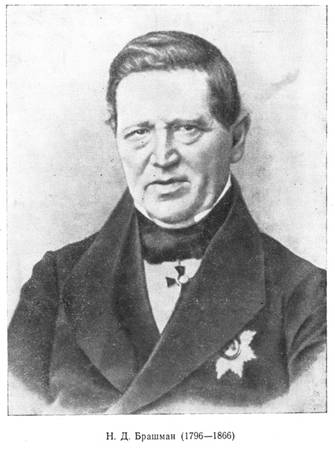 of that time.BRASHMAN NIKOLAY DMITRIEVICH (1796–1866)Professor Nikolai Dmitrievich Brashman, who held the position of
from 1834 until 1864 at Moscow University, the department of applied mathematics, under which then
mechanics was implied. He wrote the original “Course of Analytical Geometry” (M., 1836),
award-winning  Academy of Sciences.
N.D. Brashman arrived in Moscow in the fall of 1834, after he had been
worked for nine years at Kazan University under the leadership of N.I. Lobachevsky. It is not surprising that N.D. Brashman is aware of
the influence of some of Lobachevsky’s ideas is felt. This influence did not escape the reviewers of the Course by N.D. Brashman,
academicians Fuss and Collins. Reviewers noted in their review as “disapproving” some passages from
introductions that “can easily lure the student into the same useless speculations as we only recently
were proposed in the so-called 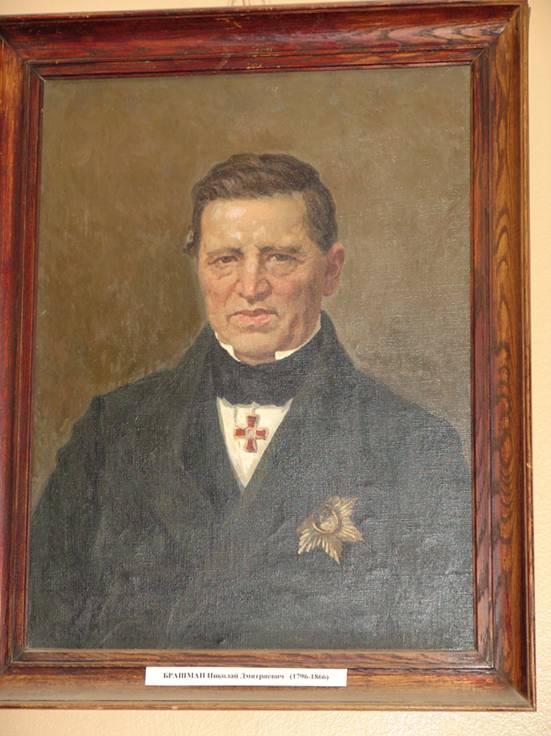 Imaginary geometry".N.D. Brashman was the initiator of the creation of the Moscow Mathematical Society in 1864. In the same year he established
at the university a prize for the best essays in mathematics. Among the many students of N.D. Brashman was P.L. Chebyshev.DAVIDOV AUGUST YULIEVICH (1823–1885)Brashman's closest student A.Yu. Davidov was his successor both in the department of applied mathematics and in teaching mechanics
at Moscow University, and for the presidency of the mathematical society. He wrote widely circulated textbooks:
"Elementary Geometry", "Elementary Algebra", "Guide to Trigonometry".
A.Yu.Davidov was engaged in both “pure” mathematics and its applications to mechanics; in particular, he invented
method of finding the equilibrium positions of a floating body.2. EARLY XX CENTURYEGOROV DMITRY FYODOROVICH (1869–1931)In the scientific activity of Dmitry Fedorovich Egorov, differential geometry occupied a central place. One of his first
works on geometry - “Towards a general theory of correspondence of surfaces”, published in 1896; 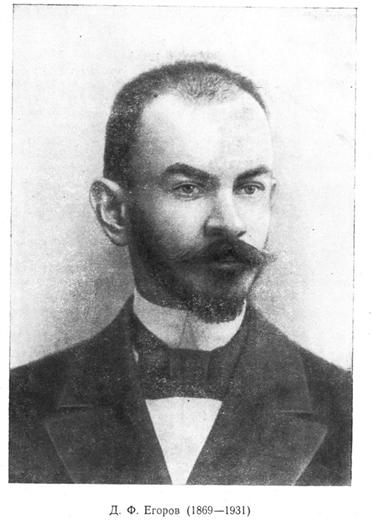 The most important work in this area is his doctoral dissertation “About one class
orthogonal systems", defended in 1901. The object of research in the dissertation is orthogonal systems
coordinate lines on the surface, which are invariant with respect to the gradient flow of some
functions ω. This is equivalent to the fact that the orthogonal system is formed by curves
u=const and v=const, with the first quadratic form of the surface
in coordinates u,v has the formds2=(∂ω/∂u)du2+(∂ω/∂v)dv2.
D.F. Egorov calls such orthogonal systems potential, and function ω - basic
function of the system.
To study potential systems, the dissertation derives equations that allow for arbitrary
 surface to find its potential orthogonal systems. In particular, for the main function of the system we received
partial differential equation of 3rd order of the following
kind
gde α=1/|dω|2+
(
[|dω|2Δω-(dω,d|dω|2)] /
[{dω,|dω|2}|dω|2]
)
2
.
*/?>
α =
+
| ( |dω|2Δω−(dω,d|dω|2) )2 | | ( {dω,|dω|2} |dω|2 )2 |
.
*/?>
α = |
|
+ |
( |dω|2Δω−(dω,d|dω|2) )2 | ( {dω,|dω|2} |dω|2 )2 |
|
Zdes kruglymi skobkami oboznacheno skalyarnoe proizvedenie v metrike poverkhnosti, a figurnymi — skobka
Puassona otnositelno sootvetstvuyushchey simplekticheskoy struktury (formy ploshchadi). Nesmotrya na ustrashayushchiy vid uravneniya,
v rabote polucheno mnogo rezultatov, opisyvayushchikh svoystva ego resheniy
(i, tem samym, potentsialnykh sistem).
Several works by D.F. Egorov are devoted to the bending of surfaces, in which the conjugacy between the selected
families of curves on a surface, as well as the question of which surfaces can be composed from lines of a fixed foliation
given surface.Geometric works by D.F. Egorov produce an unexpectedly modern impression. They are purely geometric
methods and ideas are combined with the study of complex nonlinear partial differential equations (which
At first glance they seem completely impregnable). Some of these equations are obtained as compatibility conditions
overdetermined linear systems, and sets of solutions are constructed from one initial solution by means of suitable
transformations.3. CREATION OF THE DEPARTMENT OF DIFFERENTIAL GEOMETRYIn 1922, the Department of Differential Geometry was founded at the Faculty of Mechanics and Mathematics of the Moscow State
university - one of the oldest departments of the Faculty of Mechanics and Mathematics of Moscow State University. Its first head was
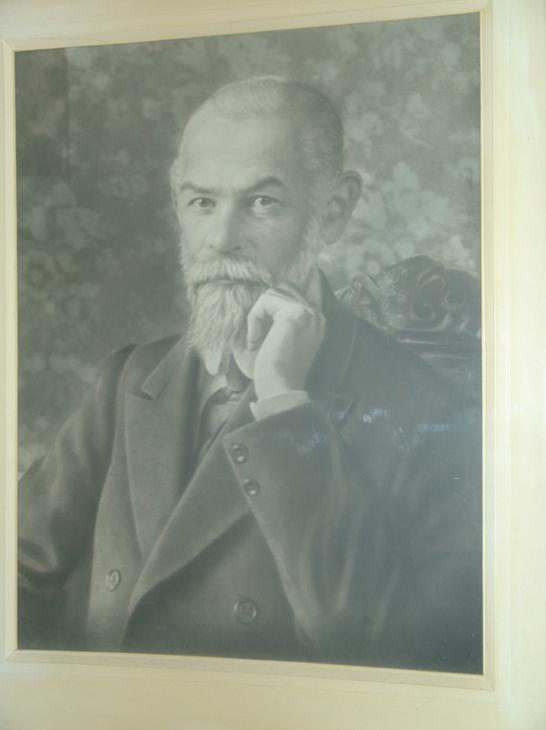
Professor Veniamin Fedorovich Kagan, then from 1952 to 1964 the department was headed by professor
Sergey Pavlovich Finikov, from 1964 to 1983 - Honored Scientist Professor Peter
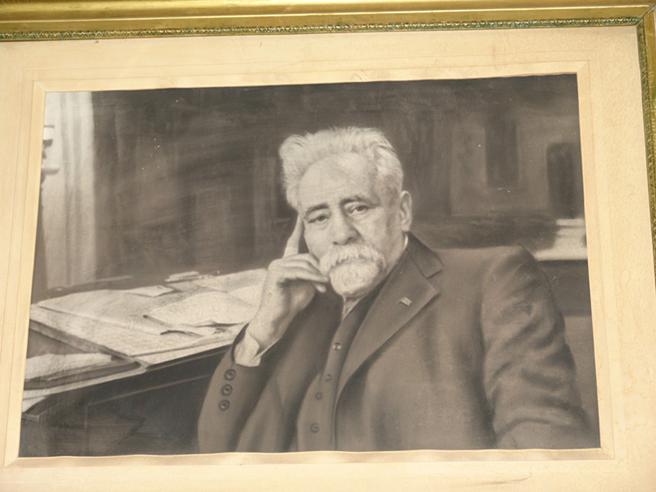 Konstantinovich Rashevsky and from 1992 to the present time — Academician of the Russian Academy of Sciences
Anatoly Timofeevich Fomenko.In the 20s and 30s, scientific work at the department was carried out by two schools. The school founded by V.F. Kagan developed tensor methods
analysis and Riemannian geometry. V.F. Kagan was engaged in deep questions of the axiomatics of geometry, research in history 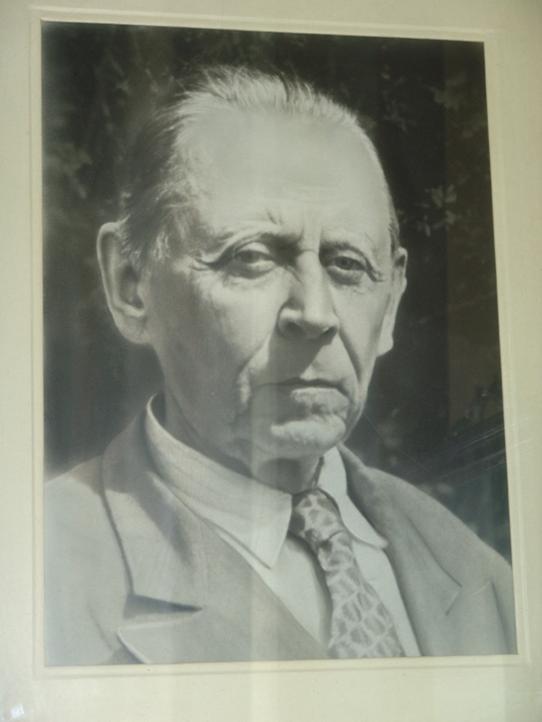 non-Euclidean geometry. In 1934 the famous international conference on differential
geometry, with the participation of the largest scientists. She played a huge role in the further development of differential
geometry and its applications, and for many years determined the main scientific directions in the field of differential geometry.In 1927 V.F. Kagan organized a seminar on vector and tensor analysis, and in 1933 created
printed organ of the seminar - “Proceedings of the seminar on vector and tensor analysis with their applications
to geometry, mechanics and physics”, regularly published until recently.Another school, the most prominent representative of which was S.P. Finikov, continued research in classical differential
geometry, developed at Moscow State University on the initiative of Professor D.F. Egorov. In 1933 the department was founded 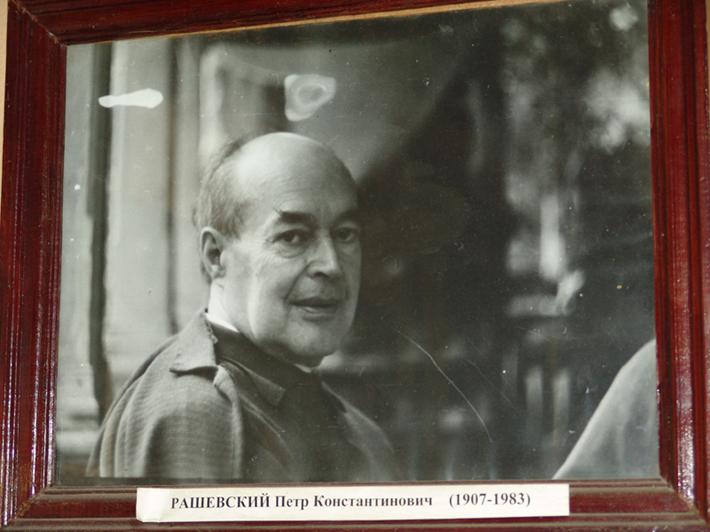 research seminar on differential geometry under the direction of S.P. Finikov. Scientific
The activities of the seminar were decisively influenced by the use and development of E. Cartan's methods.From 1964 to 1983 the department was headed by an Honored Scientist, an outstanding scientist, professor
P.K. Rashevsky, widely known for his fundamental research in the field of Riemannian geometry and tensor analysis,
theory of groups and Lie algebras and the theory of their representations. His students and the school he created also developed the theory
homogeneous spaces, methods of calculus of variations.
RASHEVSKY PETER KONSTANTINOVICH (1907, M. - 1983, M.), mathematician, geometer, doctor of physical and mathematical sciences. (1938).
Student of V.F. Kagan. Son of K.N. Rashevsky. In 1919 he and his parents moved to the city of Ranenburg (Ryazan
province), where Rashevsky's father worked as a teacher and head of the mathematics department at the Teachers' Institute.
In 1923 after graduating from school, Rashevsky returned to Moscow and entered the Faculty of Physics and Mathematics
Moscow University. In 1928 he graduated from Moscow University, in 1931 postgraduate studies there. 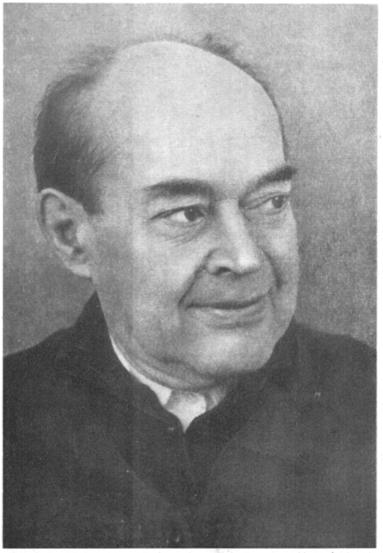 Candidate of Physical and Mathematical Sciences (1933). In 1930–34 he taught at MPEI, in 1931–41 —
at the Moscow City Pedagogical Institute (from 1934 - professor), in 1942–49 —
at MIIT. From 1938 until the end of life - professor, head of the department of Differential Geometry
Faculty of Mechanics and Mathematics of Moscow University. The founder and head of a large school of mathematicians. Perennial
editor of the Proceedings of the Seminar on Vector and Tensor Analysis with their applications to geometry, mechanics and physics and leader
this seminar at Moscow University. The main scientific works are devoted to various sections of Riemannian, affine,
differential geometry, axiomatics of projective geometry; geometry of homogeneous spaces associated with
Lie groups, theories of representations of algebras and Lie groups, theory of spinors, quantum electrodynamics,
tensor analysis and geometric theory of partial differential equations (within this
theory solved the famous problem of E. Cartan). Creator of polymetric geometry, theory of differential geometric
objects and supertensors. Author of a number of textbooks on various geometry courses. Lived on Vladimiro-Dolgorukovskaya, 7
(in early childhood); on Bolshaya Presnenskaya, 36 (1910s); in Maly Levshinsky Lane, 1
and on Academician Volgina Street, 5 (last years of life). Main works: Polymetric geometry // Proceedings of the Seminar
on vector and tensor analysis with their applications to geometry, mechanics and physics: vol. 5. M.-L., 1941;
Geometric theory of partial differential equations. 2nd ed. M., 2003; Riemannian geometry and tensor
analysis. 6th ed. M., 2008; The theory of spinors. 2nd ed. M., 2006; Differential course
geometry. 5th ed. M., 2008; On linear representations of differential groups and
Lie groups with nilpotent radical // Proceedings of Moscow. math. islands: issue. 6. M., 1957;
Associative supershell of Lie algebra, its regular representation and ideals // Ibid:
issue 15. M., 1966; On the mathematical foundations of quantum electrodynamics // Advances in mathematical sciences:
volume 12, issue. 3. M., 1958; On the dogma of the natural series // Ibid: volume 28,
issue 4, 1973.
Lit.:
Mathematics in the USSR for 30 years: 1917-1947: Sat. articles / Ed. Kurosh A. G. et al. M.; L., 1948;
Norden A.P., Rosenfeld B.A., Yaglom I.M. Pyotr Konstantinovich Rashevsky:
(To the fiftieth anniversary of his birth) // Advances in Mathematical Sciences, volume 13, issue. 1, 1958;
Efimov N.V., Solodovnikov A.S., Yaglom I.M. Pyotr Konstantinovich Rashevsky:
(On the occasion of his sixtieth birthday) // Advances in Mathematical Sciences, volume 23, no. 1, 1968;
TSB-2;
BSDET;
Bogolyubov. Mathematicians;
Professors of MU.During these years, under the leadership of P.K. Rashevsky, the department significantly expanded the scope of scientific research. Department staff
worked in a variety of areas of modern differential geometry and topology. The courses were radically modernized,
read by the department. At different times they worked at the department
Academician S.P. Novikov,
Professor A.M. Vasiliev,
Professor A.S. Mishchenko,
Professor A.T.Fomenko,
Professor Yu.P. Solovyov,
Professor V.L. Golo,
Professor A.N.Varchenko,
Professor V.V. Trofimov,
Professor L.E. Evtushik.
Senior laboratory assistant V.A. Gukovskaya devoted her entire life to the department.In 1983, after the death of the head of the department P.K. Rashevsky, by order of the rector of Moscow State University, academician A.A. Logunov, the department
was merged with the Department of Higher Geometry and Topology, and in 1992 by order of the rector of Moscow State University, academician A.A. Logunov
the Department of Differential Geometry was restored under the slightly expanded name “Department of Differential Geometry”
geometry and applications". Academician A.T. Fomenko, a direct student of P.K. Rashevsky, was appointed head. Thus,
after a short break, the Department of Differential Geometry was revived in a new capacity.4. DEPARTMENT OF DIFFERENTIAL GEOMETRY TODAYCurrently, the following employees work at the Department of Differential Geometry and Applications:
Head of the department Academician FOMENKO Anatoly Timofeevich,
professors
GOLO Voyslav Lyubomirovich,
BOLSINOV Alexey Viktorovich,
TUZHILIN Alexey Augustinovich,
IVANOV Alexander Olegovich,
SHAFAREVICH Andrey Igorevich,
OSHEMKOV Andrey Alexandrovich,
associate professors
NOSOVSKY Gleb Vladimirovich,
POPELENSKY Fedor Yurievich,
ZHEGLOV Alexander Borisovich,
SHARYGIN Georgy Igorevich,
KUDRYAVTSEVA Elena Aleksandrovna,
NIKONOV Igor Mikhailovich,
ILYUTKO Denis Petrovich,
assistants
KONYAEV Andrey Yurievich,
IZOSIMOV Anton Mikhailovich,
training master FIRSOVA Valentina Nikolaevna.Main directions of scientific activity:
- geometry and topology of integrable Hamiltonian systems
- variational problems, minimal surfaces and minimal networks
- Lie groups and algebras, applications to the theory of integrable systems and mechanics
- geometric methods and constructions in mathematical physics and theory of differential equations
- algebraic topology, non-commutative geometry
- theoretical physics, mathematical problems of biology;
- computer geometry;
- algebraic geometry and algebraic theory of integrable systems
- homotopy theory of mappings of surfaces and Morse functions
The department teaches required courses
"Classical differential geometry",
"Differential geometry and topology",
"Differential geometric and topological methods",
"Mathematical models in economics",
"Financial and economic management"
courses in natural science content and special courses in all areas of scientific work.The department cooperates with a number of other universities (for example, with the Faculty of Biology of Moscow State University, Moscow Institute of Physics and Technology, Moscow State Technical University); professors of the department read
these universities have specially designed geometric courses. Most courses are equipped with visual material: teachers
during lectures they show computer pictures and cartoons illustrating the theories being presented; developed at the department
computer geometric workshop.
| |
|
|