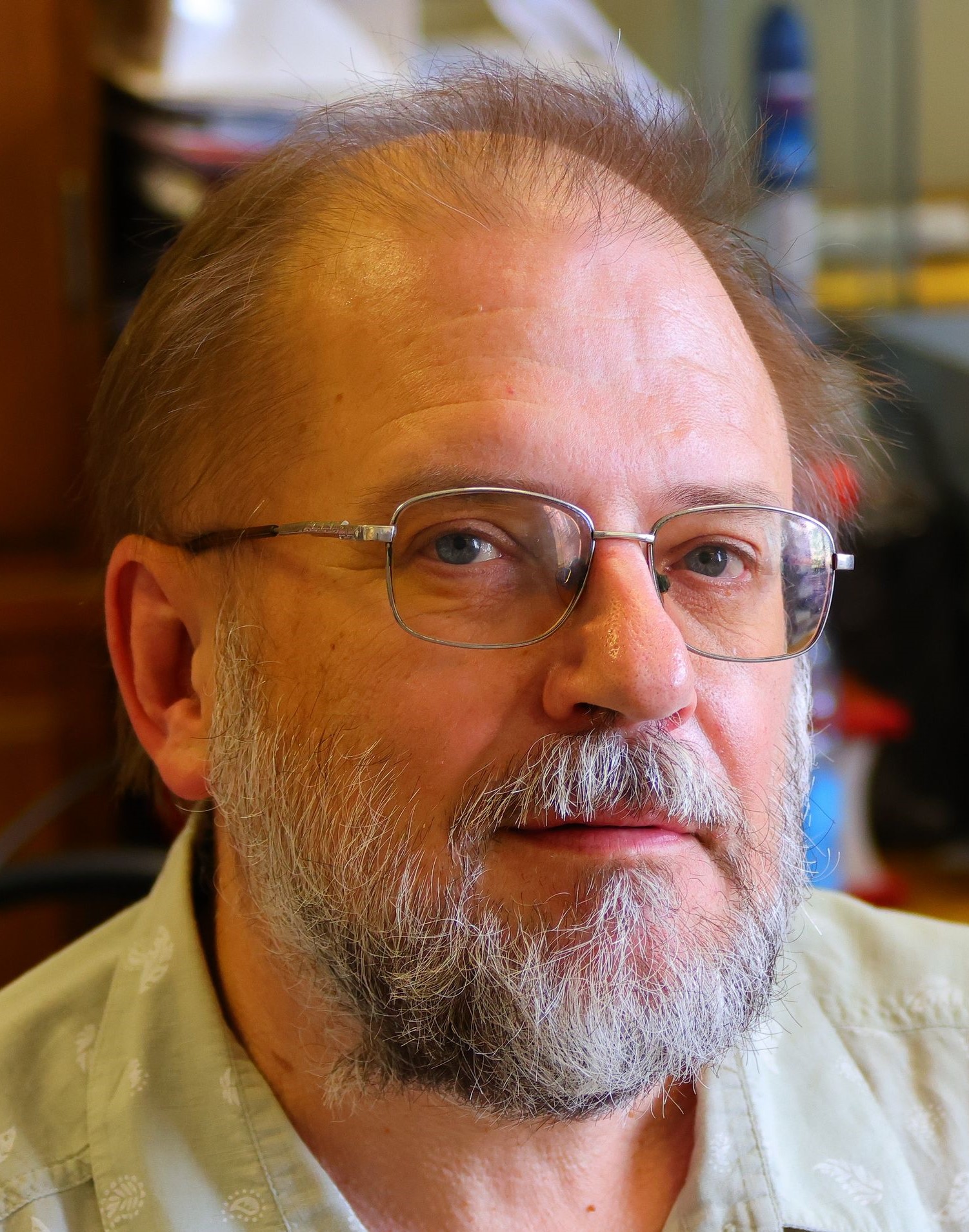
1. Life and career
Alexey A. Tuzhilin is a Russian mathematician working in geometry, the calculus of variations and metric geometry. His career has been based at the Faculty of Mechanics and Mathematics of Lomonosov Moscow State University (MSU), where he is Professor at the Department of Differential Geometry and Applications.
In 1980 he graduated with honours from the Physics and Mathematics School No. 2 in Moscow (now the Lyceum “Second School”). From 1980 to 1985 he was a student of the Faculty of Mechanics and Mathematics of MSU. In 1982 he joined the Department of Differential Geometry as a student of Anatoly Timofeevich Fomenko; his diploma thesis was devoted to bifurcations of a minimal surface under deformations of its boundary contour.
In 1985 he graduated with honours and entered the postgraduate programme at the Department of Higher Geometry and Topology, into which the Department of Differential Geometry had been merged in 1983 after the death of its head Pyotr Konstantinovich Rashevsky. From 1985 to 1988, under Fomenko’s supervision, he studied Morse-type indices of minimal surfaces, and in 1990 he defended his candidate (PhD) dissertation “A study of global properties of minimal surfaces and their indices”.
From 1989 to 1992 he worked at the Laboratory of Renewable Energy Sources of the Faculty of Geography of MSU. In 1992 he was transferred as an assistant to the newly created Department of Differential Geometry and Applications headed by Fomenko, later became a docent (associate professor), and in 2000 was appointed professor. In 1997 he defended his doctoral dissertation “Classification of locally minimal networks with convex boundaries”. In 2001, for a cycle of works on the theory of branching extremals of one-dimensional variational problems (jointly with Alexander O. Ivanov), he was awarded the I. I. Shuvalov Prize, first degree.
At the Faculty of Mechanics and Mathematics of MSU he has lectured on classical differential geometry, differential geometry and topology, and mathematical methods in economics, and has run a practicum in computer geometry. Since 2013 he has regularly taught the compulsory first-year course “Visual Geometry and Topology”. Together with Alexander Ivanov he is the author of a number of special courses also taught at the faculty, among them “Metric Geometry and Geometric Graph Theory”, “Geometric Measure Theory: An Introduction”, “The Steiner Problem: A Geometric Measure Theory Approach”, and “The Kantorovich Transport Problem and the Geometry of Spaces of Probability Measures”.
Over the years he has also worked part-time at other Moscow universities and institutions, in particular at the Moscow State University of Commerce, the Institute of Natural Sciences and Ecology (now part of MIPT), and the Russian Research Centre of Roentgenoradiology. He has been a visiting professor at the Institute of Mathematics of the University of Campinas, at the University of Bonn, at the Max Planck Institute in Leipzig, at Nanyang Technological University, and at Harbin Polytechnic University (China). He was a member of the expert council of the Higher Attestation Commission (VAK) and of the Academic Council of the Faculty of Mechanics and Mathematics of MSU. He heads the Laboratory of Computer Methods in Natural Sciences and Humanities. He serves on the editorial boards of the Scopus-indexed international journals Mathematics in Engineering, Science and Aerospace (MESA) and Discrete Mathematics, Algorithms and Applications. He has repeatedly participated in grants of the Russian Foundation for Basic Research, in grants of the President of the Russian Federation supporting young scientists and leading scientific schools, and in international grants such as INTAS.
2. Degrees and positions
| Candidate of Physical and Mathematical Sciences (PhD) | 1990, Faculty of Mechanics and Mathematics, MSU. Thesis: “A study of global properties of minimal surfaces and their indices” (advisor: A. T. Fomenko). |
| Doctor of Physical and Mathematical Sciences | 1997, Faculty of Mechanics and Mathematics, MSU. Thesis: “Classification of locally minimal networks with convex boundaries” (scientific consultant: A. T. Fomenko). |
| Professor | since 2000. Professor in the specialty 01.01.04 “Geometry and Topology” since 30 October 2019 (ISTINA record). |
| Affiliation | Lomonosov Moscow State University, Faculty of Mechanics and Mathematics, Department of Differential Geometry and Applications. |
| Research fields | Topological calculus of variations; theory of extremal networks, branching geodesics and the Steiner problem; graph theory; computer geometry; metric geometry and the Gromov–Hausdorff distance; minimal fillings; applications in bioinformatics and mathematical economics. |
3. Research
A. A. Tuzhilin is a specialist, known in Russia and abroad, in topological calculus of variations, the theory of extremal networks (in particular branching geodesics and the Steiner problem), graph theory and computer geometry; in recent decades his main research focus has been the geometry of the Gromov–Hausdorff distance and the theory of minimal fillings.
His candidate dissertation (1990, advisor A. T. Fomenko) was devoted to Morse-type indices of two-dimensional minimal surfaces. He developed effective methods for computing the indices of two-dimensional minimal surfaces in three-dimensional Euclidean space in terms of the Weierstrass representation, which yielded concrete index values for all classical two-dimensional minimal surfaces. He also studied the stability of catenoids in three-dimensional Lobachevsky space. These results attracted considerable interest both in the USSR and abroad.
His further research concentrated on the classical Steiner problem (the one-dimensional analogue of the Plateau problem) and its generalizations. A. A. Tuzhilin is one of the authors of the theory of branching extremals of one-dimensional variational problems. This theory arose at the junction of differential geometry, the calculus of variations and graph theory in an attempt to find a geometric approach to the Steiner problem. It made it possible to discover a number of new geometric effects and to establish relations between the geometry of boundary sets and the topology of extremal networks, and between the structure of extremal networks and metric and topological characteristics of the ambient manifold. Possible applications of the theory of branching extremals include transportation problems, molecular biology, the theory of evolution and mathematical economics. This subject formed the basis of his doctoral dissertation (1997).
Minimal surfaces
- Morse-type indices of two-dimensional minimal surfaces in R3 and H3; explicit index values for all classical minimal surfaces via the Weierstrass representation.
- Stability of catenoids in three-dimensional Lobachevsky space.
Minimal networks and the Steiner problem
- Classification of planar locally minimal binary trees with convex boundary; an original language of so-called “parquets” was developed, giving an effective description of possible structures of locally minimal binary trees and a number of non-trivial results on their geometry.
- Description of the local structure of locally minimal networks on Riemannian manifolds, for two main classes of admissible deformations (parametric networks and networks-traces), together with existence theorems for extremal networks on Riemannian manifolds.
- Classification of closed locally minimal networks on closed surfaces of non-negative curvature: the types are classified by the quotient of integer matrices by the action of a cyclic group of order 6, which yields, for each manifold, a complete list of possible topologies of closed minimal networks.
- Restrictions on the possible topology of a planar locally minimal binary tree in terms of the number of convexity levels of its boundary set; these results extend to ordinary planar linear trees and their geometric boundaries.
- Description of the space of locally minimal networks of a given topology with a given boundary in a multidimensional space: this space is a polyhedral set whose dimension can be computed in terms of the topology of the network.
- Structure of extremal networks on the Manhattan plane and in other normed spaces; it turned out that in normed spaces the class of locally minimal networks and the class of extremal networks differ, and a criterion of extremality of a locally minimal network was obtained for the Manhattan plane.
- Theory of branching extremals of functionals of Lagrange type, including their local structure and existence theorems.
- An estimate of the Steiner ratio of an arbitrary Riemannian manifold in terms of the Steiner ratio of Euclidean space; computation of the Steiner ratios of flat tori, flat Klein bottles and the projective plane.
- Directional differentiability and explicit formulas for the derivatives of the length of a minimal spanning tree, of a shortest tree and of the Steiner ratio on Riemannian manifolds as functions of the boundary set; a criterion for a boundary set to be extremal for the Steiner ratio.
- Study of immersed polygons, that is, piecewise affine maps of an ordinary plane polygon into the plane: every immersed polygon admits a diagonal triangulation, and the closure of an arbitrary monotone polygonal line is the boundary of some immersed polygon.
- Description of countable subsets of a metric space that admit connection by a tree of finite length; the criterion makes it possible, in particular, to compute the length of a minimal spanning tree as an integral of a real function constructed from the boundary set.
- Proof of the uniqueness of the shortest tree in the Euclidean plane for boundary sets in general position.
- Stabilization theorem: after adding a sufficient number of boundary vertices on the edges of a locally minimal tree, the tree becomes a shortest tree.
- Generalization of Maxwell’s formula for the length of a planar locally minimal binary tree.
- Description of small neighbourhoods of the lunes of planar Steiner minimal trees; in particular, the stabilization theorem was extended to the case of two disjoint locally minimal trees (jointly with O. Syedina).
Minimal fillings
- A new mathematical theory created at the interface of the theory of extremal networks and Gromov’s theory of minimal fillings.
- Conditions for the existence of a minimal spanning tree for infinite boundaries.
- The one-dimensional Gromov minimal filling problem, including fillings with negative edge weights and the dual linear programming problem.
Gromov–Hausdorff geometry
- Foundations of the theory of Steiner minimal networks in spaces of compact subsets of metric spaces endowed with Hausdorff metrics; a non-trivial example of a solution of the Steiner problem was given for a boundary consisting of three pairs of points of the Euclidean plane, each pair containing a vertex of a fixed regular triangle and the point obtained from it by a rotation through 60 degrees about the centre of the triangle (jointly with A. Tropin).
- Proof that the Gromov–Hausdorff metric restricted to the set of isometry classes of compact metric spaces (the metric of the Gromov–Hausdorff space) is strictly intrinsic: any two points of the Gromov–Hausdorff space are joined by a shortest curve whose length equals the distance between its endpoints (jointly with N. Nikolaeva).
- Proof that the Gromov–Hausdorff distance between compact metric spaces is attained both on a correspondence and on a pseudometric defined on the disjoint union of these spaces and extending their metrics.
- Proof that every finite subset of the Gromov–Hausdorff space consisting of finite metric spaces is joined by a shortest tree, and this tree can be chosen so that all its Steiner points are finite metric spaces (jointly with N. Nikolaeva).
- Proof that every finite metric space is isometrically embeddable into the Gromov–Hausdorff space.
- Computation of the Steiner ratio and the Steiner–Gromov ratio of the Gromov–Hausdorff space; an upper bound for the subratio of Steiner (it turned out to be less than 1).
- Proof that the edge lengths of a minimal spanning tree constructed on a finite metric space equal the Gromov–Hausdorff distances from this space to the corresponding simplexes.
- Proof that the isometry group of the Gromov–Hausdorff space is trivial.
- A solution of the generalized Borsuk problem in terms of the Gromov–Hausdorff distance.
- Computation, in terms of the Gromov–Hausdorff distance, of the chromatic number and of the minimum size of a clique cover of an arbitrary graph.
- Within the von Neumann–Bernays–Gödel axiomatics, a formal construction of the proper class of all metric spaces considered up to isometry, endowed with the Gromov–Hausdorff distance; it is shown that on this class the Gromov–Hausdorff distance is a complete intrinsic generalized pseudometric.
- Geometry of clouds in the Gromov–Hausdorff class (completeness, centres, path connectivity of spheres), isometric embeddings of bounded metric spaces, the Gromov–Hausdorff distance between an interval and a circle, Hausdorff implementation of linear geodesics, the local structure of the Gromov–Hausdorff space around generic finite metric spaces, the continuous Gromov–Hausdorff distance (jointly with S. Bogatyi), the Gromov–Hausdorff distance and the Jung constant, and the Mazur–Ulam theorem in terms of the Gromov–Hausdorff distance.
Applications
- A program for modelling the chemical laboratory of a living cell (its first version was developed by Professor A. S. Mishchenko).
- A geometric approach to the study of polymer conformations in terms of the curvature and torsion of the polygonal lines describing these conformations.
- A program for modelling the origin and evolution of tissues in living organisms.
- Teaching and research in bioinformatics: a special course on applications of geometry to bioinformatics (with A. O. Ivanov and A. S. Mishchenko); leadership of a group in a joint RFBR–CNRS project on mathematical methods for identifying the structures of large molecules; co-leadership of a seminar on mathematical modelling in biology; cooperation with specialists of the Russian Research Centre of Roentgenoradiology.
- Textbooks and courses on mathematical models in economics.
4. Teaching
A. A. Tuzhilin is active in teaching. He lectures on the compulsory course “Geometry-2” for the special stream of the Faculty of Mechanics and Mathematics of MSU; for many years he taught the compulsory course “Visual Geometry and Topology”. He is one of the authors of several compulsory courses at the faculty, namely “Mathematical Methods in Economics”, “Computer Geometry Practicum”, “Visual Geometry and Topology” and “Geometry-2”. He teaches special courses, takes part in leading several research seminars, and serves on examination commissions. In recent years, together with A. O. Ivanov, he has created and taught a new special course every year.
Recent courses (ISTINA)
- Classical and Continuous Gromov–Hausdorff Distances (2026)
- Visual Geometry and Topology; Geometry and Topology-2 (compulsory, 2025–2026)
- Gromov–Hausdorff Distance and Algebraic Topology (2025)
- Geometric Optimization: An Introduction (2025, distance course)
- Geometry of Quantum Gromov–Hausdorff Distance, parts III–IV (2023–2024)
- Theory of Extremal Networks (2023–2025)
- Metric Geometry: Some Recent Results (2021)
- Geometric Measure Theory (2020, distance course)
- Finite Metric Spaces: Geometry, Combinatorics, Optimization (2020, distance course)
- Geometry of Spaces of Compact Sets with Hausdorff and Gromov–Hausdorff Metrics; Gromov Metric Triples (2020)
- Classical Differential Geometry for the Special Stream (2020)
He is one of the founders and leaders of the scientific seminar on the theory of extremals of geometric variational problems and metric geometry at the Faculty of Mechanics and Mathematics of MSU. He supervises term papers, diploma theses and dissertations.
5. Doctoral students
Under the supervision of A. A. Tuzhilin the following candidate (PhD) dissertations have been defended:
- 2023 — Arsen Kh. Galstyan, “The Fermat–Steiner problem in hyperspaces”.
- 2022 — V. M. Chikin, “Deformations of metrics: local and global aspects”.
- 2020 — E. I. Stepanova, “Bifurcations of minimal networks and minimal fillings of finite subsets of the Euclidean plane” (co-supervised with A. O. Ivanov).
- 2013 — N. P. Strelkova, “Minimal networks on surfaces of polyhedra”.
- 2005 — D. P. Ilyutko, “Geometry of locally minimal and extremal networks in normed spaces”.
- 2001 — G. A. Karpunin, “Morse theory of minimal networks”.
The Russian research page additionally names two dissertations defended under his supervision: that of I. V. Ptitsyna, “Closed locally minimal networks on closed two-dimensional surfaces of constant Gaussian curvature” (co-supervised with A. T. Fomenko and A. O. Ivanov), and that of N. S. Gusev, “Multidimensional trace-polyhedra and geometric variational problems” (co-supervised with A. O. Ivanov). According to ISTINA, he has supervised 30 specialist and master’s theses and 42 term papers, many of them on the geometry of the Gromov–Hausdorff distance, the Steiner problem, minimal fillings and optimal networks.
Examples of supervised student topics
Selected titles:
- Locally minimal networks on Riemannian manifolds; Morse theory of planar locally minimal trees.
- Geometry of locally minimal and extremal networks in normed spaces; the Steiner problem on the hexagonal plane; the Fermat problem on the tri-plane.
- Closed locally minimal networks on tetrahedra, on the surface of a cube, and on two-dimensional surfaces of constant negative curvature.
- The Steiner problem with partially free boundary; the Steiner problem for a regular polygon on the Lobachevsky plane and on the sphere.
- Minimal fillings for a regular polygon in the Euclidean plane; transformations of a metric preserving the types of minimal fillings; topological properties of the weight of a minimal filling.
- The Steiner problem in the Gromov–Hausdorff space: the case of three-point metric spaces; optimal position of compact sets in spaces with a Euclidean-invariant Gromov–Hausdorff metric.
- Linear connectivity of the sphere in the Gromov–Hausdorff space; convexity of the ball in the Gromov–Hausdorff space; non-compactness of a segment in the Gromov–Hausdorff space.
- Gromov–Hausdorff distances between normed spaces; Gromov–Hausdorff distance and ultrametric spaces; stabilization of embedded regular curves on normed planes.
- Mathematical modelling of the cell cycle, gene–protein networks and protein synthesis; reconstruction of a phylogenetic tree from a set of subtrees; modelling of the spatial structure of polymers.
6. Awards and service
Awards and honours
- 2001 — I. I. Shuvalov Prize, first degree (jointly with A. O. Ivanov), Moscow State University, for a cycle of works on the theory of branching extremals of one-dimensional variational problems.
- 2021 — Prize of the MSU Development Programme (jointly with A. B. Zheglov and G. I. Sharygin).
- 2017, 2018, 2020 — Elsevier “Recognised Reviewer” certificates (Journal of Combinatorial Theory; Discrete Mathematics; Topology and its Applications).
Editorial boards
- Mathematics in Engineering, Science and Aerospace (Cambridge Scientific Publishers), since 2010.
- Discrete Mathematics, Algorithms and Applications, since 2008.
- Proceedings of the Seminar on Vector and Tensor Analysis (Trudy seminara po vektornomu i tenzornomu analizu), since 2005.
Scientific community
- Member of the expert council of the Higher Attestation Commission (VAK); member of the Academic Council of the Faculty of Mechanics and Mathematics of MSU (in previous years).
- Member of the dissertation council 1.1.2 “Differential Equations and Mathematical Physics” at the Moscow Institute of Physics and Technology (2025–2026).
- Member of programme and organizing committees of international conferences, including the XXII and XXIII Geometrical Seminars (Vrnjačka Banja, 2024; Zlatibor, 2026), the Conference on Geometry, Integrable Systems and Statistics (Wuhan, 2024), the Al-Khorezmi International Conference (Urgench, 2022), and conferences on classical and modern geometry in Moscow, Ryazan and Volgograd.
- Head of the Laboratory of Computer Methods in Natural Sciences and Humanities.
Research projects (ISTINA)
- 2025–2026 — “Contact and metric structures in geometry and in the theory of nonlinear differential equations” (principal investigator).
- 2021–2022 — “Modern geometric methods and their applications”.
- 2019–2021 — “Geometry and topology of manifolds, dynamical systems and Hamiltonian systems”.
- 2016–2018 — “Geometry and topology of manifolds and dynamical systems”.
- 2018–2019 and 2016–2017 — “Differential geometry and applications”.
- 2015–2018 — “Scientific foundations of the creation of the National Bank-Depository of Living Systems”.
- 2014–2015 — “Differential geometry and applications”.
- 2011–2015 — “Computer methods in natural sciences and humanities” (co-leader, with A. T. Fomenko).
7. Books and textbooks
- A. T. Fomenko, A. A. Tuzhilin. Elements of the Geometry and Topology of Minimal Surfaces in Three-Dimensional Space. Moscow: Nauka, 1991, 176 pp.; English translation: Translations of Mathematical Monographs, vol. 93, American Mathematical Society, 1992, 142 pp.
- A. O. Ivanov, A. A. Tuzhilin. Minimal Networks: The Steiner Problem and Its Generalizations. Boca Raton, FL: CRC Press, 1994, 442 pp.
- A. O. Ivanov, A. A. Tuzhilin. Branching Geodesics: The Geometric Theory of Locally Minimal Networks. Lewiston; Queenston; Lampeter: The Edwin Mellen Press, 1999.
- A. O. Ivanov, A. A. Tuzhilin. Branching Solutions to One-Dimensional Variational Problems. River Edge, NJ: World Scientific, 2001, 364 pp.
- A. O. Ivanov, A. A. Tuzhilin. Theory of Extremal Networks. Moscow–Izhevsk: Regular and Chaotic Dynamics; Institute of Computer Research, 2003, 424 pp. (in Russian).
- V. V. Trofimov, A. A. Tuzhilin. Mathematical Models of Economics. 2005 (in Russian).
- A. O. Ivanov, A. A. Tuzhilin. Lectures on Classical Differential Geometry. Moscow: Universitetskaya Kniga; Logos, 2009, 224 pp. (in Russian).
- A. O. Ivanov, D. P. Ilyutko, G. V. Nosovsky, A. A. Tuzhilin, A. T. Fomenko. Computer Geometry: A Practicum. Moscow: Internet University of Information Technologies, 2010, 391 pp.; URSS, 2023, 376 pp.; 2nd revised edition, URSS, 2024, 384 pp. (in Russian).
- I. M. Nikonov, A. A. Tuzhilin. Mathematical Models of Economics: Spring Semester. Moscow: Publishing House of the Board of Trustees of the Faculty of Mechanics and Mathematics of MSU, 2012, 120 pp. (in Russian).
- A. A. Oshemkov, F. Yu. Popelensky, A. A. Tuzhilin, A. T. Fomenko, A. I. Shafarevich. A Course in Visual Geometry and Topology. Moscow: URSS, 2014, 360 pp. (in Russian).
- A. O. Ivanov, A. A. Tuzhilin. Geometry of Hausdorff and Gromov–Hausdorff Distances: The Case of Compact Sets. Moscow: Publishing House of the Board of Trustees of the Faculty of Mechanics and Mathematics of MSU, 2017, 111 pp. (in Russian).
- A. O. Ivanov, A. A. Tuzhilin. Geometric Measure Theory, Part 1. Moscow: Publishing House of the Board of Trustees of the Faculty of Mechanics and Mathematics of MSU, 2018, 165 pp. (in Russian).
- A. O. Ivanov, A. A. Tuzhilin. The Steiner Problem: A Geometric Measure Theory Approach. Moscow: Publishing House of the Board of Trustees of the Faculty of Mechanics and Mathematics of MSU, 2018, 116 pp. (in Russian).
- I. M. Nikonov, V. V. Trofimov, A. A. Tuzhilin. Mathematical Models of Economics, Part 2: Economic Equilibrium. Moscow: MAKS Press, 2026, 120 pp. (in Russian).
Reprints and revised editions of the books above (URSS, 2014 and 2022 for the minimal-surfaces book; URSS, 2023 and 2024 for the computer-geometry practicum) are listed separately in the ISTINA profile.
8. Selected publications
- Morse-type indices of two-dimensional minimal surfaces in R3 and H3. Mathematics of the USSR — Izvestiya 38(3), 575–598 (1992). doi
- Solution of the Steiner problem for convex boundaries. Russian Mathematical Surveys 45(2), 214–215 (1990). doi
- Geometry of minimal networks and the one-dimensional Plateau problem. Russian Mathematical Surveys 47(2), 59–131 (1992). doi
- Classification of closed minimal networks on flat two-dimensional tori. Sbornik: Mathematics 77(2), 391–425 (1994). doi
- The geometry of plane linear trees. Russian Mathematical Surveys 51(2), 329–330 (1996). doi
- Minimal binary trees with regular boundary: the case of skeletons with four ends. Sbornik: Mathematics 187(4), 581–622 (1996). doi
- Geometry of convex polygons and locally minimal binary trees spanning these polygons. Sbornik: Mathematics 190(1), 71–110 (1999). doi
- Steiner ratio for Riemannian manifolds. Russian Mathematical Surveys 55(6), 1150–1151 (2000). doi
- Differential calculus on the space of Steiner minimal trees in Riemannian manifolds. Sbornik: Mathematics 192(6), 823–841 (2001). doi
- Planar Manhattan local minimal and critical networks. European Journal of Combinatorics 23(8), 949–967 (2002). doi
- Steiner ratio for manifolds. Mathematical Notes 74(3), 367–374 (2003). doi
- Sets admitting connection by graphs of finite length. Sbornik: Mathematics 196(6), 845–884 (2005). doi
- Uniqueness of Steiner minimal trees on boundaries in general position. Sbornik: Mathematics 197(9), 1309–1340 (2006). doi
- Immersed polygons and their diagonal triangulations. Izvestiya: Mathematics 72(1), 63–90 (2008). doi
- One-dimensional Gromov minimal filling problem. Sbornik: Mathematics 203(5), 677–726 (2012). doi
- One-dimensional minimal fillings with negative edge weights. Moscow University Mathematics Bulletin 67(5–6), 189–194 (2012). doi
- Gromov minimal fillings for finite metric spaces. Publications de l’Institut Mathématique (Beograd) 94, 3–15 (2013). doi
- Critical analysis of amino acids and polypeptides geometry (with A. O. Ivanov, A. S. Mishchenko). In: Continuous and Distributed Systems: Theory and Applications, Springer, vol. 2, 29–74 (2015).
- The Gromov–Hausdorff metric on the space of compact metric spaces is strictly intrinsic (with A. O. Ivanov, N. K. Nikolaeva). Mathematical Notes 100(6), 171–173 (2016). doi
- Minimal networks: a review (with A. O. Ivanov). In: Advances in Dynamical Systems and Control, Studies in Systems, Decision and Control, vol. 69, Springer, 43–80 (2016). doi
- Local structure of Gromov–Hausdorff space, and isometric embeddings of finite metric spaces into this space (with S. Iliadis, A. O. Ivanov). Topology and its Applications 221, 393–398 (2017). doi
- Local structure of Gromov–Hausdorff space around generic finite metric spaces (with A. O. Ivanov). Lobachevskii Journal of Mathematics 38(6), 998–1006 (2017). doi
- Fermat–Steiner problem in the metric space of compact sets endowed with Hausdorff distance (with A. O. Ivanov, A. M. Tropin). Journal of Geometry 108(2), 575–590 (2017). doi
- Analyzing the data bank of protein space structures (PDB): a geometrical approach. Journal of Mathematical Sciences 225(4), 555–564 (2017). doi
- Steiner type ratios of Gromov–Hausdorff space (with A. O. Ivanov). European Journal of Combinatorics 80, 172–183 (2019). doi
- Steiner problem in the Gromov–Hausdorff space: the case of finite metric spaces (with A. O. Ivanov). Proceedings of the Steklov Institute of Mathematics 304(1), 88–96 (2019). doi
- Isometry group of Gromov–Hausdorff space (with A. O. Ivanov). Matematicki Vesnik 71(1–2), 123–154 (2019).
- Gromov–Hausdorff distances to simplexes and some applications to discrete optimisation (with A. O. Ivanov). Chebyshevskii Sbornik 21(2), 169–189 (2020). doi
- The Fermat–Steiner problem in the space of compact subsets of Rm endowed with the Hausdorff metric (with A. O. Ivanov, A. M. Tropin). Sbornik: Mathematics 212(1), 25–56 (2021). doi
- Geometry of the Gromov–Hausdorff distance on the class of all metric spaces (with A. O. Ivanov). Sbornik: Mathematics 213(5) (2022). doi
- Isometric embeddings of bounded metric spaces in the Gromov–Hausdorff class (with A. O. Ivanov). Sbornik: Mathematics 213(10), 1400–1414 (2022). doi
- Gromov–Hausdorff distance between interval and circle (with A. O. Ivanov). Topology and its Applications 307 (2022). doi
- Clouds in Gromov–Hausdorff class: their completeness and centers. Topology and its Applications 329 (2023). doi
- Path connectivity of spheres in the Gromov–Hausdorff class. Topology and its Applications 329 (2023). doi
- Hausdorff implementation of linear geodesics in the Gromov–Hausdorff space (with A. O. Ivanov). Journal of Mathematical Sciences 277 (2023). doi
- Metric space recognition by Gromov–Hausdorff distances to simplexes (with A. O. Ivanov, E. S. Lychagina). Lobachevskii Journal of Mathematics 46(3), 1087–1097 (2025). doi
- Surjective mappings in the Hyers–Ulam theorem and the Gromov–Hausdorff distance (with S. A. Bogatyi, E. A. Reznichenko). European Journal of Mathematics 12(4) (2026). doi
- Continuous Gromov–Hausdorff distance (with S. A. Bogatyi). Buletinul Academiei de Stiinte a Republicii Moldova. Matematica 108(2–3), 78–103 (2026).
- Minimal fillings of finite metric spaces and convex polyhedra (with A. O. Ivanov). arXiv:2607.27211 [math.MG] (2026). arXiv
Full list of publications (274 records: department page and ISTINA profile)
9. Links and sources
- ISTINA profile: istina.msu.ru/workers/1471912.
- Russian personal page at the Department of Differential Geometry and Applications: dfgm.math.msu.su/people/tuzhilin/ (short biography, research interests, publications, teaching materials).
- arXiv author page: arxiv.org/a/tuzhilin_a_1.
- Lecture materials: lectures on Hausdorff and Gromov–Hausdorff distance geometry (in English).
This English page was compiled from the department page dfgm.math.msu.su/people/tuzhilin/ (biography, research interests, teaching and supervision) and from the ISTINA profile (degrees, awards, editorial boards, courses, dissertations and the bibliographic record). Bibliographic details were checked against the ISTINA records on 11 November 2026.