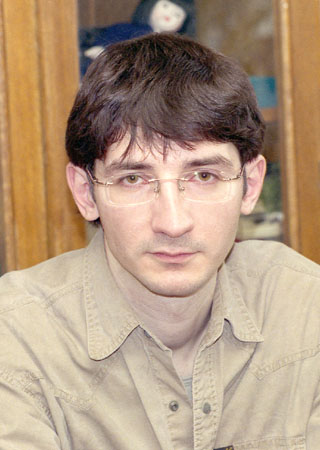
1. Life and career
Fedor Yu. Popelensky was born on 29 December 1973. In 1990 he entered the Faculty of Mechanics and Mathematics of Lomonosov Moscow State University, where his scientific advisor was Professor Yu. P. Solovyov. He graduated with honours in 1995 and entered the postgraduate programme of the Faculty. In 1999 he defended his candidate dissertation. Since 1998 he has worked at the Department of Differential Geometry and Applications.
He runs seminars on the courses “Classical Differential Geometry” and “Differential Geometry and Topology”; jointly with Professor V. V. Belokurov he gives a special course of natural-science content on quantum field theory; he is co-leader of the proseminar on geometry and topology for undergraduate students and gives the special course “Additional Chapters of Geometry and Topology”. At various times he has given special courses on manifolds of positive curvature and on elliptic curves. Part-time he has lectured the compulsory courses “Theory of Functions of a Complex Variable” and “Vector Analysis” at the K. E. Tsiolkovsky MATI. Over the years he has also worked at Moscow school No. 91. He has repeatedly taken part in conferences in Russia, Germany, France and the USA.
2. Degrees and positions
| Born | 29 December 1973. |
| Education | Faculty of Mechanics and Mathematics, MSU, 1990–1995, diploma with honours; postgraduate programme 1995–1999. |
| Candidate of Physical and Mathematical Sciences (PhD) | 1999; advisor Professor Yu. P. Solovyov. |
| Position | Department of Differential Geometry and Applications, MSU, since 1998. |
| Research fields | Algebraic topology; operads and Steenrod algebras; characteristic classes and non-commutative geometry; homological algebra; combinatorics of geometric flows; integrable billiards. |
3. Research
In the early 1970s the recognition problem for n-fold loop spaces was solved independently by several authors (J. Boardman, R. Vogt, J. P. May); J. P. May proposed a formulation of the recognition principle using operads in the topological category. In the early 1980s V. A. Smirnov showed that the notion of operad can be transferred to the category of chain complexes, and operads have since become a general mathematical tool.
Modules over one of the most interesting operads, the A∞-operad, appeared much earlier, in the early 1960s, in the work of J. Stasheff on H-spaces; such modules are now called Stasheff algebras. In the late 1990s V. A. Smirnov showed how Stasheff algebras can be used to describe the cohomology of associative algebras and obtained a complete description, in terms of generators and relations, of the cohomology of the Steenrod algebra A2. F. Yu. Popelensky transferred this description to the Steenrod algebras Ap for primes p > 2. The value of this description lies in the fact that the cohomology of the Steenrod algebra is the second term of the Adams spectral sequence for stable homotopy groups of spheres.
To use such a description one has to develop computational techniques in Stasheff algebras. For associative algebras, a special case of Stasheff algebras, there is a rich theory of Groebner bases allowing effective computations in algebras given by generators and an ideal of relations. F. Yu. Popelensky constructed the corresponding theory for a special class of Stasheff algebras.
Other lines of his work include additive bases and their changes in the C-motivic Steenrod algebra, the action of reduced powers on the homology of products of complex projective spaces and lens spaces, algebraic and homological aspects of Hermitian K-theory, cohomology rings of partially projective quaternionic Stiefel manifolds, weighted combinatorial Ricci and Yamabe flows, and surfaces of constant energy for billiard systems with cosine refraction.
4. Teaching
F. Yu. Popelensky teaches the compulsory courses “Classical Differential Geometry” and “Differential Geometry and Topology”, the proseminar on geometry and topology for junior students, and special courses on quantum field theory (jointly with Professor V. V. Belokurov), on additional chapters of geometry and topology, on manifolds of positive curvature and on elliptic curves.
5. Recent publications
Full list of publications — 124 records (department page and ISTINA profile)
- Action of reduced powers on the homology of products of complex projective spaces and products of lens spaces. Russian Journal of Mathematical Physics, vol. 32, no. 1 (2025), pp. 150–159.
- A. Kryazhev, D. Kuznetsov, F. Yu. Popelensky. Conjugation equation for quaternionic conjugation spaces. Russian Journal of Mathematical Physics, vol. 32, no. 1 (2025), pp. 105–122.
- On additive bases and their changes in the mod 2 C-motivic Steenrod algebra. Proceedings of the Steklov Institute of Mathematics, vol. 330 (2025), pp. 1–20.
- M. A. Nikulin, F. Yu. Popelensky. Level surfaces of the integral for a billiard system with cosine refraction. Matematicheskii Sbornik, vol. 216, no. 10 (2025), pp. 101–158.
- M. A. Nikulin, F. Yu. Popelensky, A. I. Shafarevich. Asymptotic behaviour of energy levels of a quantum free particle in an elliptic sector. Physica Scripta, vol. 99, no. 1 (2024), 015207.
- Algebraic and homological aspects of Hermitian K-theory. Proceedings of the Steklov Institute of Mathematics, vol. 325 (2024), pp. 244–276.
- A note on the weighted Yamabe flow. Regular and Chaotic Dynamics, vol. 28, no. 3 (2023), pp. 309–320.
- Weighted combinatorial Ricci flow and metrics defined by degenerate circle packings. Filomat, vol. 37, no. 25 (2023), pp. 8675–8681.
- G. E. Zhubanov, F. Yu. Popelensky. On the cohomology rings of partially projective quaternionic Stiefel manifolds. Matematicheskii Sbornik, vol. 213, no. 3 (2022), pp. 21–41.
- R. Y. Pepa, F. Yu. Popelensky. On combinatorial geometric flows of two-dimensional surfaces. Russian Mathematics, vol. 65 (2021), pp. 60–68.
- T. V. Ovchinnikova, F. Yu. Popelensky. On triangular changes of bases in the mod p Steenrod algebra. Journal of Mathematical Sciences, vol. 259, no. 5 (2021), pp. 699–711.
The full list of publications (124 records) is given on the Full list of publications page.
6. Links and sources
- Russian personal page: dfgm.math.msu.su/people/popelen/.
- ISTINA profile: istina.msu.ru.
Compiled from the department page dfgm.math.msu.su/people/popelen/. The recent publications listed above are the newest items of the Russian list; titles of Russian-language papers are translated into English.