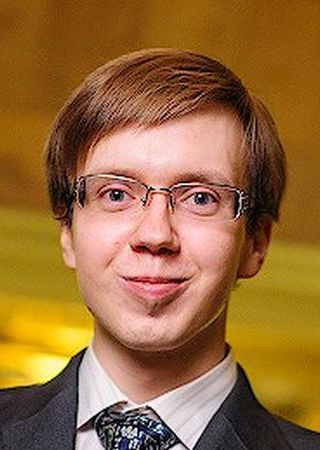
1. Life and career
Vladislav A. Kibkalo was born on 9 November 1994 in the town of Arzamas-16 (now Sarov). From 2001 to 2012 he studied at Gymnasium No. 2 in Sarov, which he finished in 2012 with a gold medal. In his senior years he took part in various olympiads (prize-winner of the All-Russian Olympiad in mathematics, physics and geography) and completed the correspondence schools in physics and mathematics (ZFTSH and the Small Mech-Math).
In 2012 he entered the Division of Mathematics of the Faculty of Mechanics and Mathematics of Moscow University and graduated with honours in 2018 at the Department of Differential Geometry and Applications. His diploma thesis was “Topological invariants of the Liouville foliation for an analogue of the Kovalevskaya integrability case” (advisors Academician A. T. Fomenko and I. K. Kozlov).
In 2018 he entered the postgraduate programme at the Department and in 2021 defended his candidate dissertation ahead of schedule: “Topology of integrable multiparameter analogues of the Kovalevskaya system on Lie algebras”, specialty 01.01.04 “Geometry and Topology”, advisor Academician A. T. Fomenko.
Since 2020 he has worked at the Department of Differential Geometry and Applications, first as an assistant and since 2025 as a docent. In 2019–2020 he also worked at the Faculty of Mechanics and Mathematics and at the Moscow Centre for Fundamental and Applied Mathematics (Matcentre of MSU) within departmental projects. He teaches compulsory courses of the Department and gives a special course on integrable systems and billiards, and takes part in the work of the departmental seminars. Since 2016 he has taught the practicum in computer geometry for undergraduate students.
Since 2025 he has been a senior researcher at the Centre for Artificial Intelligence of MSU. Since 2026 he has been Deputy Head of the Laboratory of Differential Geometry of Integrable Systems (headed by A. Yu. Konyaev, scientific supervisor Academician A. T. Fomenko), created within the Matcentre of MSU on the basis of the Department.
He is the author and co-author of 28 publications in peer-reviewed journals and of one textbook. His results have been presented at leading conferences on geometry, topology and the theory of integrable systems in Russia and abroad (Greece, China, Mexico, the Netherlands, Germany, Japan) and at all six conferences of the Mathematical Centres of Russia. He leads a project supported by the Russian Science Foundation (research of youth scientific groups). Since 2022 he has led research projects of the Department supported by the Russian Science Foundation, and since 2020 he has taken part in the applied projects of the Department (headed by Professor A. O. Ivanov) as a contact person and leading researcher on applications of geometry to data analysis, to navigation in spaces with complex geometry and topology, and to interdisciplinary work with biologists and VR technologies. He carries out organisational work for the Department and the Faculty: since 2024 he has been academic secretary of the Dissertation Council MSU.011.4.
In 2025 he became a laureate of the Presidential Prize of the Russian Federation for young scientists.
2. Degrees and positions
| Born | 9 November 1994, Arzamas-16 (now Sarov). |
| Education | Faculty of Mechanics and Mathematics, MSU, 2012–2018, diploma with honours; postgraduate programme 2018–2021. |
| Candidate of Physical and Mathematical Sciences (PhD) | 2021 (defended ahead of schedule), specialty 01.01.04 “Geometry and Topology”; advisor Academician A. T. Fomenko. Thesis: “Topology of integrable multiparameter analogues of the Kovalevskaya system on Lie algebras”. |
| Positions | Assistant (2020–2025), Docent (since 2025), Department of Differential Geometry and Applications, MSU; Senior Researcher, Centre for Artificial Intelligence of MSU (since 2025); Deputy Head, Laboratory of Differential Geometry of Integrable Systems (since 2026); academic secretary of the Dissertation Council MSU.011.4 (since 2024). |
| Awards | Laureate of the Presidential Prize of the Russian Federation for young scientists (2025). |
| Research fields | Topological invariants of integrable systems of dynamics and their analogues for Lie algebras; integrable billiards and billiard books; singularities of integrable Hamiltonian systems and their bifurcations; applications of geometric methods in data analysis. |
3. Research
The main field of V. A. Kibkalo is the theory of integrable Hamiltonian systems and the adjacent questions of geometry, mechanics, algebra, singularity theory and low-dimensional topology. Three main topics are pursued:
- Topological invariants of integrable systems of dynamics and their analogues for various Lie algebras; integrable systems in non-Euclidean spaces. For analogues of the classical Kovalevskaya system in the cases of the Lie algebras so(4) and so(3,1) the Fomenko–Zieschang invariants of constant-energy surfaces were computed, and for so(4) the topology of the three-dimensional non-singular surfaces themselves was described. Analogues of well-known integrable systems in pseudo-Euclidean space are studied; for such an analogue of the Kovalevskaya system a criterion of compactness of the common level of the first integrals was proved, together with the existence of bifurcations of the foliation occurring without a drop in the rank of the moment map.
- Integrable billiards and their generalizations. Billiard books (two-dimensional cell complexes with permutations on 1-edges, introduced by V. V. Vedyushkina) were constructed whose motion of a particle in a repelling Hooke potential models an arbitrary semi-local singularity of rank 0 of product type (for systems with two degrees of freedom). The question of modelling an arbitrary Liouville foliation of an integrable system (in some energy zone) by foliations of billiards, the well-known Fomenko conjecture on billiards, is also studied. Within its local version it was proved (jointly with V. V. Vedyushkina) that every value of the label n, an integer invariant corresponding to the Euler class of a Seifert bundle, is realized by a suitable billiard book; previously only the values n = 0, 1, 2, 4 were known.
- Singularities of Liouville-integrable Hamiltonian systems and their bifurcations in one-parameter families, their topological and symplectic invariants, classification and structural stability. For the classical Kovalevskaya system of rigid body dynamics all its parabolic singularities were described and a complete answer on their structural stability was obtained (jointly with Professor E. A. Kudryavtseva).
V. A. Kibkalo is also interested in applications of geometric methods to applied problems, including data analysis (testing the manifold hypothesis for the output of a neural network); he takes part in the corresponding projects of the Department and in conferences.
4. Teaching and projects
He teaches compulsory courses of the Department, gives the special course on integrable systems and billiards, and since 2016 has taught the practicum in computer geometry. He leads RSF projects at the Department:
- 22-71-00111 “Integrable systems of dynamics in non-Euclidean spaces and topology of non-compact foliations”, 2022–2024 (completed);
- 24-71-10100 “Topological and geometric methods in the study of non-singular flows on manifolds, integrable systems and their singularities”, 2024–2027.
5. Publications
Full list of publications — 153 records (department page and ISTINA profile)
- The topology of the analogue of the Kovalevskaya integrability case on the Lie algebra so(4) under zero area integral. Moscow University Mathematics Bulletin, 71:3 (2016), pp. 119–123.
- Topological analysis of the Liouville foliation for the Kovalevskaya integrable case on the Lie algebra so(4). Lobachevskii Journal of Mathematics, 39:9 (2018), pp. 1396–1399.
- Topological classification of Liouville foliations for the Kovalevskaya integrable case on the Lie algebra so(4). Matematicheskii Sbornik, 210:5 (2019), pp. 3–40; English transl. Sbornik: Mathematics, 210:5 (2019), pp. 625–662.
- Billiards with potential model a series of four-dimensional singularities of integrable systems. In: Contemporary Problems of Mathematics and Mechanics. Proceedings of the International Conference dedicated to the 80th birthday of Academician V. A. Sadovnichii, vol. 2, Moscow, 2019, pp. 563–566.
- Topological classification of Liouville foliations for the Kovalevskaya integrable case on the Lie algebra so(3,1). Topology and its Applications, 275 (2020), 107028, 13 pp.
- V. V. Vedyushkina, V. A. Kibkalo, A. T. Fomenko. Topological modelling of integrable systems by billiards: realization of numerical invariants. Doklady Mathematics, 102:1 (2020), pp. 269–271.
- V. V. Vedyushkina, V. A. Kibkalo. Billiard realization of the numerical invariant of the Seifert fibration of integrable systems. Moscow University Mathematics Bulletin, 75:4 (2020), pp. 22–28.
- Non-compactness of fibres and singularities of the non-Euclidean Kovalevskaya system on a pencil of Lie algebras. Moscow University Mathematics Bulletin, 75:6 (2020), pp. 56–59.
- A. T. Fomenko, V. A. Kibkalo. Saddle singularities in integrable Hamiltonian systems: examples and algorithms. In: Contemporary Approaches and Methods in Fundamental Mathematics and Mechanics (Understanding Complex Systems), Springer, Cham, 2021.
- V. A. Kibkalo, A. T. Fomenko, I. S. Kharcheva. Realizing integrable Hamiltonian systems by means of billiard books. Transactions of the Moscow Mathematical Society, 82 (2021), pp. 37–64.
- Topology of integrable multiparameter analogues of the Kovalevskaya system on Lie algebras. Candidate dissertation, Moscow, MSU, 2021, 178 pp.
- V. V. Vedyushkina, V. A. Kibkalo, S. E. Pustovoitov. Realization of focus singularities of integrable systems by billiard books with Hooke potential. Chebyshevskii Sbornik, 22:5 (2021), pp. 44–57.
- V. Kibkalo, T. Yokoyama. Topological characterizations of Morse–Smale flows on surfaces and generic non-Morse–Smale flows. Discrete and Continuous Dynamical Systems, 42:10 (2022), pp. 4787–4822.
- A. T. Fomenko, V. A. Kibkalo. Topology of Liouville foliations of integrable billiards on table-complexes. European Journal of Mathematics, 8:4 (2022), pp. 1392–1423.
- V. V. Vedyushkina, V. A. Kibkalo. Billiard books of small complexity and the realization of Liouville foliations of integrable systems. Chebyshevskii Sbornik, 23:1 (2022), pp. 53–82.
- Parabolicity of degenerate singularities in axisymmetric Euler systems with a gyrostat. Moscow University Mathematics Bulletin, 78:1 (2023), pp. 28–36.
- M. K. Altuev, V. A. Kibkalo. Topological analysis of the pseudo-Euclidean Euler top for special values of the parameters. Matematicheskii Sbornik, 214:3 (2023), pp. 54–70; English transl. Sbornik: Mathematics, 214:3 (2023), pp. 334–348.
- The first Appelrot class of the pseudo-Euclidean Kovalevskaya system. Chebyshevskii Sbornik, 24:1 (2023), pp. 69–88.
- A. Z. Ali, V. A. Kibkalo, E. A. Kudryavtseva, M. V. Onufrienko. Bifurcations in integrable Hamiltonian systems near corank-one singularities. Differential Equations, 60:10 (2024), pp. 1311–1368.
- E. S. Agureeva, V. A. Kibkalo. Topological analysis of the axisymmetric Zhukovsky system in the case of the Lie algebra e(2,1). Moscow University Mathematics Bulletin, 79:5 (2024), pp. 207–222.
- A. T. Fomenko, A. I. Shafarevich, V. A. Kibkalo. Main recent directions and achievements of the Chair of Differential Geometry and Applications. Moscow University Mathematics Bulletin, 79:6 (2024), pp. 283–295.
- V. A. Kibkalo, D. A. Tuniyants. Ordered billiard games and topological properties of billiard books. Journal of Mathematical Sciences, 292:1 (2025), pp. 86–99.
- N. A. Belousov, V. A. Kibkalo. Invariants of the pseudo-Euclidean Euler top with non-compact leaves. Moscow University Mathematics Bulletin, 80:3 (2025), pp. 167–172.
- V. A. Kibkalo, M. A. Nikulin, V. V. Vedyushkina. Liouville foliations of confocal billiard books with elliptic boundaries. Lobachevskii Journal of Mathematics, 46 (2025), pp. 1098–1112.
- E. S. Agureeva, V. A. Kibkalo, V. A. Chertopolokhov. Topological invariants of the pseudo-Euclidean Zhukovsky integrability case. Chebyshevskii Sbornik, 26:4 (2025), pp. 223–238.
- V. V. Vedyushkina, V. A. Kibkalo. Introduction to the theory of integrable billiards: a topological approach. Textbook, Moscow, MAKS Press, 2025, 124 pp. ISBN 978-5-317-07413-5.
Applications to data analysis
- A. Ivanov, G. Nosovskiy, A. Chekunov, D. Fedoseev, V. Kibkalo, M. Nikulin, P. Popelensky, S. Komkov, I. Mazurenko, A. Petiushko. Manifold hypothesis in data analysis: double geometrically-probabilistic approach to manifold dimension estimation. arXiv:2107.03903 [cs.LG; stat.ML].
- A. O. Ivanov, G. V. Nosovskiy, V. A. Kibkalo, M. A. Nikulin, F. Yu. Popelensky, D. A. Fedoseev, I. V. Gribushin, V. V. Zlobin, S. S. Kuzin, I. L. Mazurenko. Recognition of anomalies of a previously unknown type. Chebyshevskii Sbornik, 23:5 (2022), pp. 227–240.
- V. Chertopolokhov, A. Mukhamedov, G. Bugriy, V. Kibkalo, V. Ionkin, V. Tolchennikova, I. Chairez. Stable on-the-fly learning for dynamic neural networks with delayed inputs. IEEE Access, vol. 14, pp. 14369–14392. DOI
6. Links and sources
- Russian personal page: dfgm.math.msu.su/people/kibkalo/.
- ISTINA profile: istina.msu.ru.
Compiled from the department page dfgm.math.msu.su/people/kibkalo/ (biography, research interests, teaching, publications). Titles of Russian-language papers are translated into English; where an official English version exists, it is indicated.